
Scaphidiinae
Latreille, 1806
Shining Fungus Beetles
Genus Guides
4- Cyparium
- Scaphidium(shining fungus beetles)
- Scaphisomatini
- Scaphium(malva nut)
Scaphidiinae is a of rove beetles (Staphylinidae) commonly known as shining fungus beetles. The subfamily comprises over 2000 described across 46 , with greatest diversity concentrated in tropical and subtropical forests. Members are strongly associated with fungi and slime molds, on which they feed and complete their development. The Neotropical region remains particularly understudied, with recent work revealing substantially higher diversity than previously recorded.
Pronunciation
How to pronounce Scaphidiinae: /skæˌfɪdiˈaɪniː/
These audio files are automatically generated. While they are not always 100% accurate, they are a good starting point.
Identification
Distinguished from other Staphylinidae by the combination of broadly oval compact body, long covering most of the (leaving only terminal segments exposed), and 5-5-5 tarsal formula. The compact, rounded profile contrasts sharply with the elongate, parallel-sided form typical of most rove beetles. Identification to requires examination of detailed morphological characters including mouthpart structure and genitalia; keys to regional genera are available for Brazil and Mexico.
Images
Appearance
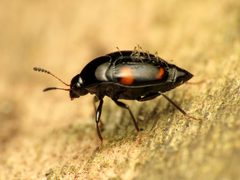
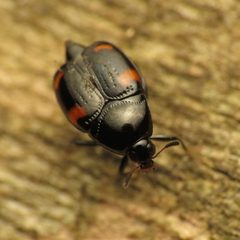
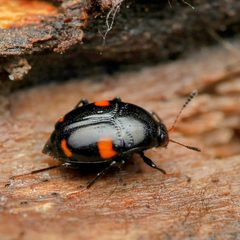
Broadly oval and compact body form, contrasting with the typically elongate shape of most Staphylinidae. are long and cover all but the last few abdominal segments. Legs are long and slender. are 5-5-5 (pentamerous on all three pairs of legs). Body size ranges from approximately 0.84–14.30 mm in length. Many exhibit a characteristic shiny or lustrous appearance.
Habitat
Forest , particularly tropical and subtropical forests. Strongly associated with fungal substrates including bracket fungi, resupinate fungi, mushrooms, and slime molds. Collections have been documented from Atlantic Forest remnants in Brazil, forests in Minas Gerais, and montane forests in Mexico (Jalisco, Morelos, Oaxaca).
Distribution
Worldwide distribution with greatest diversity in tropical regions. Documented from Neotropical, Oriental, and other tropical regions. Specific records include: Brazil (Minas Gerais, Atlantic Forest), Mexico (Jalisco, Morelos, Oaxaca), Rica. Seven and 70 recorded from North America. The genus Scaphisoma is distributed almost worldwide.
Diet
Mycophagous; feeds on fungi and slime molds. The entire has been documented as obligately associated with fungal .
Host Associations
- fungi - food and bracket fungi, resupinate fungi, mushrooms
- slime molds - food and Myxomycetes
Behavior
and larvae are found directly on fungi. Adults disperse rapidly when disturbed, making field collection challenging and dependent on collector skill and appropriate techniques. Hand collecting from host fungi is considered the most effective method, as it allows collection of both adults and larvae together to establish host associations.
Human Relevance
Subject of taxonomic research due to high undescribed diversity; recent studies from Brazil alone have described over 25 new . Collected using specialized methods including hand collecting, sifting of fungi and associated substrates, intercept traps, and . A simple low-cost collecting device has been developed specifically for mushroom-dwelling species.
Similar Taxa
- other StaphylinidaeMost rove beetles have short exposing most of the and elongate parallel-sided bodies; Scaphidiinae have long elytra covering most of the abdomen and compact oval bodies
- Coleoptera: other fungus-associated beetlesDistinctive tarsal formula (5-5-5) and body form separate Scaphidiinae from other small beetles found on fungi
More Details
Taxonomic diversity
The has experienced substantial growth in recognized diversity, increasing from just over 1000 in 1997 to over 2000 species currently, with no indication of stabilization. Brazil was previously known to harbor only 34 species and two from seven , but recent collecting has revealed considerable abundance and diversity.
Research significance
The Entomological Collection of the Laboratory of and of Coleoptera at the Federal University of Viçosa (CELC) now holds the largest collection of Scaphidiinae in Brazil, with more than 1800 specimens, enabling continued research on this group.
Sources and further reading
- BugGuide
- Wikipedia
- iNaturalist taxon
- NCBI Taxonomy
- Catalogue of Life
- Taxonomy, host associations, and collecting methods of shining fungus beetles (Coleoptera: Staphylinidae: Scaphidiinae) in fragments of the Atlantic Forest in Minas Gerais, southeastern Brazil
- Twenty new species of Scaphidiinae (Coleoptera: Staphylinidae) from Minas Gerais, Southeast Brazil
- Four new species of Scaphisoma Leach with maculate elytra (Coleoptera: Staphylinidae: Scaphidiinae) from Mexico, with new records and comments on S. balteatum Matthews
- Contributions to the taxonomy of Neotropical Cyparium Erichson (Coleoptera: Staphylinidae: Scaphidiinae), with the description of five new species
- Notes on Scaphium Kirby (Coleoptera: Staphylinidae: Scaphidiinae) with establishment of a new synonymy
- A simple, low-cost device for collecting mushroom-dwelling Scaphidiinae (Coleoptera, Staphylinidae)
- Scaphisoma pandemum sp. nov. (Coleoptera: Staphylinidae: Scaphidiinae) from the Atlantic Forest of Southeast Brazil