
Siagonium stacesmithi
Hatch, 1957
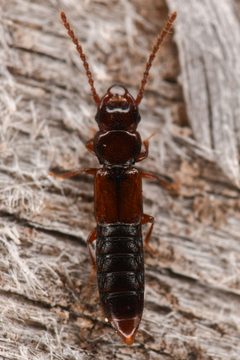
Siagonium stacesmithi is a rove beetle in the Piestinae, described by Hatch in 1957. The is known from scattered records across northern North America, including western Canada, the Yukon, and parts of the western and northeastern United States. Like other members of Siagonium, it is a small, elongate associated with forest floor . It remains poorly known biologically, with only a handful of documented observations.
Pronunciation
How to pronounce Siagonium stacesmithi: /siːˈæɡoʊniəm steɪsˈsmɪθaɪ/
These audio files are automatically generated. While they are not always 100% accurate, they are a good starting point.
Identification
Members of Siagonium can be recognized by their strongly flattened, elongate bodies and relatively long . The is distinguished from other Piestinae by the form of the and the structure of the abdominal sternites. Specific characters distinguishing S. stacesmithi from include details of the male genitalia and subtle differences in body proportions and punctation, though these require microscopic examination. Separation from the more widespread S. punctatum and other North American relies on careful comparison of or authoritative keys.
Images
Habitat
Forest floor environments, particularly in coniferous and mixed woodlands. Specimens have been collected in association with decaying organic matter and woody debris.
Distribution
Canada: Alberta, British Columbia, Manitoba, New Brunswick, Ontario, Quebec, Saskatchewan, Yukon Territory. United States: Colorado, New Hampshire, Wyoming.
Similar Taxa
- Siagonium punctatumOverlaps in range and ; distinguished by genitalic characters and subtle differences in body form and surface .
More Details
Etymology
The specific epithet 'stacesmithi' honors Stace Smith, though the exact identity of this person has not been traced in available literature.
Taxonomic history
Described by Melville Hatch in 1957 as part of his extensive work on Pacific Northwest Coleoptera. The has received little subsequent taxonomic attention.
Conservation status
Not evaluated; insufficient data available to assess trends or threats.