
Piestinae
Erichson, 1839
Genus Guides
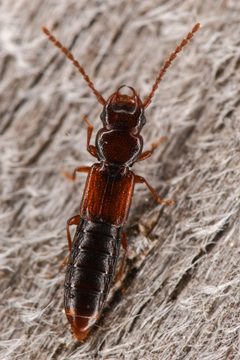
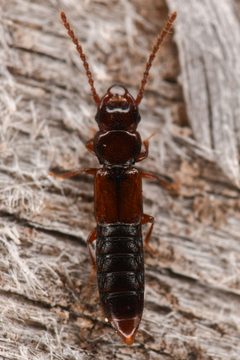
3Piestinae is a of rove beetles (Staphylinidae) characterized by an elongate, flattened body form and inserted beneath shelf-like projections of the . Members are primarily associated with decaying wood , where many occur under bark. The subfamily includes several , notably Piestus and Siagonium. Ecologically, they function as saprophages or mycophages in dead wood .

Pronunciation
How to pronounce Piestinae: /paɪˈɛstɪniː/
These audio files are automatically generated. While they are not always 100% accurate, they are a good starting point.
Identification
Distinguished from other staphylinid by the combination of: (1) inserted beneath shelf-like extensions of the rather than exposed on the surface; (2) strongly flattened, parallel-sided body form; and (3) 5-5-5 tarsal formula. The concealed antennal bases are particularly diagnostic when examining the head in lateral or view.
Images
Habitat
Primarily associated with dead and decaying wood; many occur under the bark of decaying trees. The is strongly tied to saproxylic (dead wood) across their range.
Distribution
Widespread in distribution with records from multiple continents; specific range boundaries are poorly documented for the as a whole. Individual have documented occurrences in North America, Europe, and other regions.
Diet
Saprophagy and mycophagy—feeding on decaying organic matter and fungi associated with dead wood.
Ecological Role
Contributes to decomposition processes in dead wood through saprophagous and mycophagous feeding habits. Functions as part of the saproxylic in forest .
Human Relevance
Collected by entomologists through the specific technique of 'barking'—removing bark from decaying trees to access specimens. No documented economic or medical significance.
Similar Taxa
- Other Staphylinidae subfamiliesDifferentiated by the diagnostic antennal insertion under shelf-like frontal projections and the strongly flattened, parallel-sided body form; most other rove beetles have exposed antennal insertions and more cylindrical or less flattened bodies.
More Details
Collection method
The specialized technique of 'barking'—removing bark from decaying trees—is the standard method for collecting Piestinae specimens.
Taxonomic history
Established by Erichson in 1839; the has undergone limited revision with modern treatments following Newton et al. (2001) in American Beetles.