
Paederus iowensis
(Casey, 1905)
Iowa Tomcat Rove Beetle
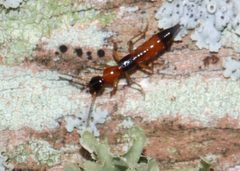
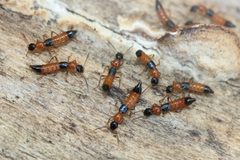
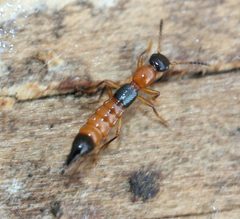
Paederus iowensis is a small rove beetle in the Staphylinidae, commonly known as the Iowa Tomcat Rove Beetle. Like other members of the Paederus, it possesses specialized defensive glands containing , a potent vesicant compound that can cause dermatitis upon contact with human skin. The is native to the midwestern and northeastern United States and adjacent Canada.
Pronunciation
How to pronounce Paederus iowensis: /ˈpʰiːdərəs aɪəˈwɛnsɪs/
These audio files are automatically generated. While they are not always 100% accurate, they are a good starting point.
Identification
Belongs to the Paederus, characterized by slender, somewhat flattened bodies with relatively long that leave only a few abdominal segments exposed. Distinguished from other Paederus by geographic distribution and subtle morphological features; precise identification requires examination of male genitalia and other microscopic characters. The bright aposematic coloration typical of many Paederus species—often combining black with red or orange markings—serves as a warning of chemical defense.
Images
Distribution
Recorded from Canada (Ontario, Quebec) and the United States (Connecticut, Iowa, Massachusetts, Michigan, Minnesota, New York, Wisconsin). The name reflects its type locality in Iowa.
Human Relevance
Contact with can cause Paederus dermatitis (whiplash dermatitis), a painful skin irritation resulting from exposure. This occurs when beetles are crushed against skin, not from active biting or stinging. Medical significance is generally lower than tropical Paederus such as P. sabaeus, which are responsible for more frequent and severe cases of dermatitis in East Africa.
Similar Taxa
- Paederus fuscipesOverlapping general and chemical defense system; distinguished by geographic range (P. fuscipes occurs in southern Europe, Asia, and Africa) and specific structural features
- Other Paederus speciesMany share similar body plan and -based chemical defense; accurate identification requires detailed examination of genitalia and other fine morphological characters
More Details
Chemical Defense
Produces , a polyketide amide synthesized by bacterial endosymbionts (Pseudomonas ). This compound is among the most potent animal toxins known, causing severe blistering dermatitis at nanogram concentrations.
Etymology
The specific epithet 'iowensis' refers to the state of Iowa, where the was first described.
Sources and further reading
- BugGuide
- GBIF taxonomy match
- iNaturalist taxon
- Catalogue of Life
- UC Davis Doctoral Students in Entomology Got It Right | Bug Squad
- Paederus fuscipes rove beetle and Skeeter drone model - Entomology Today
- The Sting of Defeat: A Brief History of Insects in Warfare
- Building a Better Grasshopper Trap: New Design Offers Safer, More Efficient Harvest
- Quiz Yourself: 2020 Entomology Games Questions