
Paederus
Fabricius, 1775
Whiplash Beetles
Species Guides
5- Paederus grandis
- Paederus iowensis(Iowa Tomcat Rove Beetle)
- Paederus littorarius(Shore Rove Beetle)
- Paederus mexicanus
- Paederus obliteratus
Paederus is a large of rove beetles comprising over 600 . Members are distinguished from most other rove beetles by bright aposematic coloration, activity, and attraction to lights. Several species contain , a potent vesicant toxin produced by endosymbiotic bacteria, which causes paederus dermatitis when contacts human skin. Both larvae and are predatory on other insects.
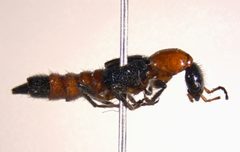
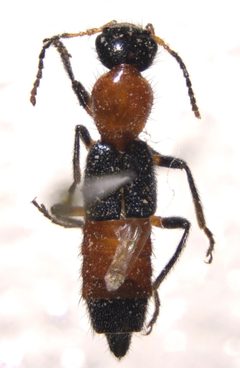
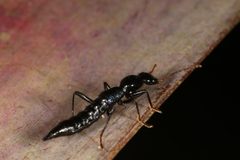
Pronunciation
How to pronounce Paederus: //ˈpiːdərəs//
These audio files are automatically generated. While they are not always 100% accurate, they are a good starting point.
Identification
Paederus are distinguished from most other rove beetles by bright coloration: metallic blue or green combined with orange or red on the pronotum and basal abdominal segments. This contrasts with the typically dull coloration of other Staphylinidae. Unlike most rove beetles, Paederus species are active during daylight hours. The belongs to the subtribe Paederina within the Paederinae.
Images
Habitat
Paederus inhabit moist environments. are laid singly in moist . Large numbers are attracted to irrigated farmland due to preference for moist soil conditions.
Distribution
Widely distributed globally. Specific distribution records include Denmark, Norway, and Sweden (GBIF).
Diet
Both larvae and are predatory on other insects. Specific prey includes aphids ( spp.) based on laboratory studies, though natural field diet requires confirmation.
Life Cycle
are laid singly in moist . Larvae pass through two instars before .
Behavior
activity distinguishes Paederus from most rove beetles, which are . Adults are attracted to bright lights after nightfall. rate increases with prey following a Type II model, with hunger state influencing predation levels.
Ecological Role
of other insects. Potential agent for pest management in agricultural settings, though field efficacy remains to be established.
Human Relevance
Several cause paederus dermatitis (also called whiplash dermatitis, linear dermatitis, or Nairobi fly dermatitis) when crushed against skin, releasing toxin from . This causes delayed-onset skin irritation appearing 12–36 hours after contact, with erythema progressing to blisters and irritation lasting 2–3 weeks. Conjunctivitis from contact is called 'Nairobi eye' in East Africa. Historical use in warfare has been proposed, with Paederus beetles possibly included in projectiles during the Second Parthian War. Modern have occurred in hospitals, factories, and military bases worldwide.
Similar Taxa
- Other StaphylinidaeMost rove beetles are dull-colored and , whereas Paederus display bright aposematic coloration and activity.
More Details
Pederin toxin
is a vesicant toxin present in the of many Paederus females. It is manufactured by endosymbiotic bacteria, probably Pseudomonas , not by the beetles themselves. At least 20 of over 600 Paederus species have been associated with dermatitis.
Plague of Egypt hypothesis
A 2002 scholarly paper proposed that Paederus could have been responsible for the biblical of 'boils,' suggesting environmental conditions from earlier plagues would have favored breeding.
Sources and further reading
- BugGuide
- Wikipedia
- GBIF taxonomy match
- iNaturalist taxon
- NCBI Taxonomy
- Catalogue of Life
- UC Davis Doctoral Students in Entomology Got It Right | Bug Squad
- Paederus fuscipes rove beetle and Skeeter drone model - Entomology Today
- The Sting of Defeat: A Brief History of Insects in Warfare
- Building a Better Grasshopper Trap: New Design Offers Safer, More Efficient Harvest
- Quiz Yourself: 2020 Entomology Games Questions
- FUNCTIONAL RESPONSE OF PREDATOR Paederus sp. (COLEOPTERA: STAPHYLINIDAE)