
Paederina
Fleming, 1821
Genus Guides
1- Paederus(Whiplash Beetles)
Paederina is a subtribe of small rove beetles (Staphylinidae) within the Paederinae. Members are typically found in moist microhabitats including leaf litter, moss, and rotting plant material. Some exhibit reduced or absent wings, resulting in flightless restricted to specific montane or riparian . The subtribe includes such as Paederus and Pseudomedon, with larvae known to prey on mites and Collembola under laboratory conditions.
Pronunciation
How to pronounce Paederina: //paɪˈdɛrɪnə//
These audio files are automatically generated. While they are not always 100% accurate, they are a good starting point.
Identification
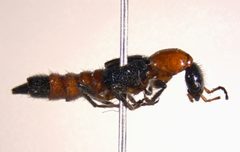
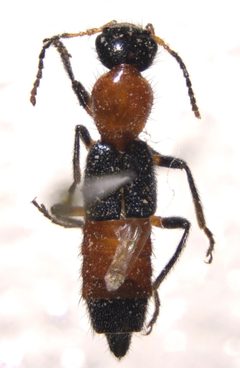
Larvae of Paederina can be distinguished from other Paederinae subtribes by specific morphological characters including chaetotaxy patterns and body proportions; an identification key for larvae exists at the subtribe level. of some (e.g., Paederus) exhibit distinctive color patterns with dark blue or black markings contrasting against reddish-brown body segments. have completely reduced hind wings. Male genitalia analysis is often required for species-level identification, particularly in genera such as Pseudomedon where external is highly similar among .
Images
Habitat
Moist microhabitats including wet margins of water bodies, river banks, lake shores, oxbows, peat bogs, and floodplain forests. Found under rotting plant remains, in flushes, among mosses, and in leaf litter. Wintering sites include reed litter and piles of straw. Montane occupy elevations of 1480–3000 m in shrub , mixed and coniferous forests, and areas with loose gravel and grass roots.
Distribution
Palaearctic region from the Iberian Peninsula to Kazakhstan; additional records from Afrotropical, Australasian, Nearctic, and Oriental regions. In China, documented from southern Xizang, eastern Chongqing, Hubei Province, and Zhejiang Province. One known only from westernmost Yunnan Province near the Myanmar border. GBIF records indicate presence in Parque Nacional Natural Serranía de Chiribiquete, Colombia.
Seasonality
and larvae have been reared from March to June at 20±3°C under laboratory conditions. Specimens collected in the field in June.
Diet
Mites and Collembola of various (based on laboratory rearing of Pseudomedon obsoletus larvae; not confirmed from field observations).
Life Cycle
Two larval instars observed (L1 and L2). Rearing period documented as March to June at 20±3°C.
Behavior
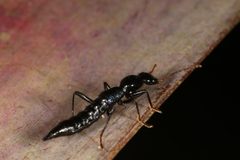
Some are (flightless) with reduced or completely absent hind wings, restricting . Rarely encountered in Europe, usually caught singly; greater numbers found only at wintering sites. Some regarded as distinctly declining in parts of Europe. Specimens have been observed moving under fresh grass along river sides.
Similar Taxa
- Paederinae (other subtribes)Larvae distinguished by subtribe-specific morphological characters including chaetotaxy and body proportions; identification key available for Paederinae larvae.
More Details
Taxonomic Note
Paederina Bordoni, 1975 is listed as a with DOUBTFUL status in GBIF, while Catalogue of Life recognizes Paederina Fleming, 1821 as an accepted subtribe. The provided context treats Paederina as a subtribe.
Sources and further reading
- BugGuide
- Wikipedia
- GBIF taxonomy match
- iNaturalist taxon
- Catalogue of Life
- Six new species of micropterous Paederus (Coleoptera, Staphylinidae, Paederinae) from China.
- The third species of the genus Pachypaederus Fagel, 1958 (Coleoptera, Staphylinidae, Paederinae) from the Oriental region.
- Synthesis of Current Knowledge of the Morphology of the Larval Stages of Paederinae (Coleoptera; Staphylinidae), with a First Insight into the Mature Larva of Pseudomedon Mulsant & Rey, 1878, in the Light of a New Systematic Division.