
Osoriini
Erichson, 1839
Genus Guides
3- Holotrochus
- Mimogonia
- Osorius(unmargined rove beetles)
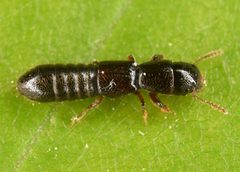
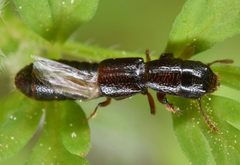
Osoriini is a tribe of rove beetles within the Staphylinidae, Osoriinae. Members are characterized by their small size and compact body form relative to other staphylinids. The tribe was established by Erichson in 1839 and contains numerous distributed across multiple continents. Osoriini beetles are primarily found in soil and leaf litter where they contribute to decomposition processes.
Pronunciation
How to pronounce Osoriini: /ɒs.ɔːr.iˈaɪ.naɪ/
These audio files are automatically generated. While they are not always 100% accurate, they are a good starting point.
Identification
Distinguished from other Osoriinae tribes by combinations of: antennal structure (number and form of segments, presence or absence of club); tarsal formula; presence or absence of elytral ; and male genitalia characteristics. Separation from Thoracophorini (the other major tribe in Osoriinae) often requires examination of detailed mouthpart and genitalic structures. Identification to level typically requires microscopic examination of subtle morphological characters including patterns on the , details of the labial palpi, and precise antennal proportions.
Images
Habitat
Predominantly found in moist terrestrial microhabitats including soil, leaf litter, humus, decaying wood, and moss. Many are associated with forest floor environments, though some occur in grasslands, wetlands, and disturbed . The tribe shows preference for humid, shaded conditions with abundant organic matter. Some species have been collected from nests or colonies, though the extent of these associations varies.
Distribution
distribution with representatives on all continents except Antarctica. Particular diversity in tropical and subtropical regions, with significant radiations in the Neotropics, Afrotropics, and Indo-Malayan region. Temperate zones of North America, Europe, and Asia harbor fewer but well-established . Many show restricted geographic ranges, while a few are broadly distributed.
Seasonality
Activity patterns vary by and climate. In temperate regions, are most commonly encountered from spring through autumn, with reduced winter activity. Tropical species may be active year-round. Some species show peaks associated with rainfall patterns or seasonal leaf litter accumulation. Specific phenological data is sparse for most species.
Behavior
Primarily ground-dwelling and cryptic, spending much of their within soil and litter matrices. Locomotion is relatively slow compared to more agile staphylinid groups. Many are capable of burrowing through loose substrates. Defensive have not been well documented, though chemical defenses are suspected given the -wide of such adaptations. capability is reduced or absent in many species, suggesting limited ability.
Ecological Role
Contributors to soil and litter decomposition as part of the . Their feeding activities likely accelerate breakdown of organic matter and nutrient cycling. on small such as , enchytraeids, and microarthropods has been suggested for some but requires further documentation. Serve as prey for larger soil-dwelling invertebrates and small vertebrates.
Human Relevance
No direct economic importance. Occasionally encountered in soil by ecologists and agricultural researchers. Some may be present in composting operations or organic agricultural systems, where they contribute to soil health processes. Not known to be pests or of .
Similar Taxa
- ThoracophoriniThe other major tribe in Osoriinae; distinguished by differences in mouthpart structure, particularly the form of the and , and details of the male genitalia. Thoracophorini often have more elongate body forms and different antennal proportions.
- Other Staphylininae tribesOsoriini are distinguished from most other rove beetle tribes by their compact body form, reduced or absent wings, and association with soil/litter microhabitats rather than more exposed surfaces. Detailed examination of thoracic and abdominal is often required for definitive separation.
More Details
Taxonomic complexity
Osoriini contains a large number of (exceeding 50) and , with ongoing revisions revealing cryptic diversity. The tribal boundaries and internal relationships remain active areas of research, with molecular increasingly informing traditional -based classifications.
Collection challenges
Members of this tribe are often underrepresented in collections due to their small size, cryptic habits, and the specialized techniques required for effective sampling (e.g., , Winkler extractors, careful hand-sorting of litter). This likely leads to underestimation of their true abundance and diversity in many regions.