
Osorius
Guérin-Méneville, 1829
unmargined rove beetles
Species Guides
2- Osorius latipes
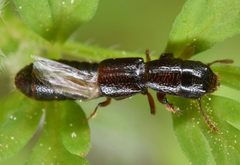
- Osorius planifrons(unmargined rove beetle)
Osorius is a of unmargined rove beetles in the Staphylinidae, first described by Guérin-Méneville in 1829. The genus contains approximately nine described distributed primarily in North America. Members of Osorius are characterized by the absence of lateral margins on the , a trait that distinguishes them within the Osoriinae. These beetles are ground-dwelling and associated with moist, decaying organic matter.
Pronunciation
How to pronounce Osorius: /oˈsoː.ri.us/
These audio files are automatically generated. While they are not always 100% accurate, they are a good starting point.
Identification
Osorius can be distinguished from other Osoriinae by the lack of distinct lateral margins on the , hence the "unmargined rove beetles." This contrasts with related genera such as Osorius, which typically possess well-developed elytral margins. The genus is further characterized by the general body plan of osoriine rove beetles: compact body, short elytra exposing most of the , and reduced or absent wings. -level identification requires examination of male genitalia and subtle differences in and pronotal structure.
Images
Habitat
of Osorius are ground-dwelling beetles associated with moist microhabitats rich in decaying organic matter. They have been recorded from forest floor litter, decaying wood, and other decomposing plant material. Specific microhabitat preferences vary by species, with some showing affinity for particular decay stages or substrate types.
Distribution
The Osorius is primarily distributed in North America. Described occur across temperate regions of the United States and Canada, with records from the eastern, central, and western portions of the continent. The genus appears to be absent from the Neotropics, distinguishing it from the more broadly distributed and speciose related genera.
Similar Taxa
- OsoriusThe Osorius is most frequently confused with Osorius, a closely related and morphologically similar genus in the tribe Osoriinae. Osorius possess distinct lateral margins on the , whereas Osorius species lack these margins entirely. This character is visible under low magnification and provides reliable separation between the two genera.
- Other Osoriinae generaWithin the Osoriinae, Osorius may be confused with such as Thoracophorus or Microosorius. These genera typically differ in pronotal shape, presence or absence of wing rudiments, and details of the antennal club structure. Examination of the elytral margin condition remains the primary diagnostic feature for recognizing Osorius.
More Details
Taxonomic history
The Osorius was established by Guérin-Méneville in 1829. The concept of "unmargined" rove beetles has undergone revision, and boundaries within the genus have been refined through the work of Notman (1920s) and subsequent authors. The genus currently contains nine recognized species, though additional undescribed species may exist given the cryptic nature of these beetles and limited collecting in some regions.
Research limitations
Detailed biological studies of Osorius are scarce. A 1978 study titled " and of Osorius planifrons" was published in the Annals of the Entomological Society of America, but the abstract provides no specific findings. The full article likely contains the most detailed behavioral and ecological data available for any in the .