
Osoriinae
Erichson, 1839
Tribe Guides
3- Eleusinini
- Osoriini
- Thoracophorini(unmargined rove beetles)
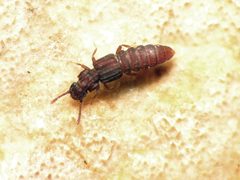
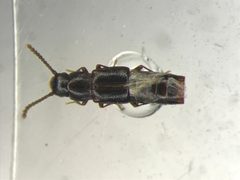
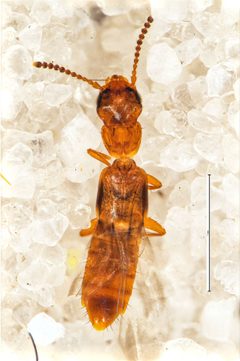
Osoriinae is a of rove beetles (Staphylinidae) containing over 100 organized into multiple tribes. The subfamily is predominantly tropical and subtropical in distribution, with occurring in leaf litter, under bark, in nests, and in tree . Many species exhibit flattened body forms adapted for moving through confined spaces.
Pronunciation
How to pronounce Osoriinae: /oˈsɔ.ri.aɪ.neɪ/
These audio files are automatically generated. While they are not always 100% accurate, they are a good starting point.
Identification
Distinguished from other Staphylinidae by the combination of flattened body form and parallel-sided with distinctive lateral . Tribe-level identification requires examination of mouthpart structure, tarsal formula, and male genitalia. within Osoriinae are distinguished by characters of the , pronotum, and abdominal segments.
Images
Habitat
Leaf litter, under bark, in nests, tree , and tree trunks. Some are subcortical (living under bark), others are truly myrmecophilous (ant-associated).
Distribution
Mainly tropical and subtropical regions worldwide. Documented from Neotropical region (Central and South America), Australia, Oriental-Indian Ocean region, and recorded in southeastern United States.
Diet
and fungivores.
Host Associations
- Iridomyrmex nitidus - myrmecophilousMyrmelibia kingi is probably -specific with this
- ants - myrmecophilousMany Thoracophorus may be associated with ants
- termites - potentially associatedMany Thoracophorus might be associated with
Life Cycle
Larvae have been described for some ; and larvae may cohabit in subcortical .
Behavior
Some are myrmecophilous, living in nests. Accidental transport through soil and ornamental plants has been documented for at least one pantropical species. Subcortical habits common in several lineages.
Ecological Role
Decomposers in forest , contributing to breakdown of leaf litter and fungal material. Some may serve as in and colonies.
Human Relevance
Some are non-native and potentially , introduced through soil and ornamental plant trade. Insect monitoring in urban environments can detect such introductions.
Similar Taxa
- other Staphylinidae subfamiliesOsoriinae distinguished by flattened, parallel-sided with distinctive lateral ; other lack this specific abdominal structure
More Details
Tribal classification
Osoriinae contains at least four tribes: Eleusinini, Leptochirini, Osoriini, and Thoracophorini. The subtribe Glyptomina has been elevated to tribal status (Glyptomini) based on larval and morphological evidence.
Fossil record
The Priochirus is known from mid-Cretaceous Kachin amber, indicating ancient lineage within the .
Sources and further reading
- BugGuide
- Wikipedia
- iNaturalist taxon
- NCBI Taxonomy
- Catalogue of Life
- First record of Mimogonus fumator (Fauvel, 1889) (Coleoptera: Staphylinidae: Osoriinae) in the USA, with a synopsis of the Osoriinae of the Southeastern USA
- The Neotropical species of the genus Osoriellus FAGEL, 1959 (Coleoptera: Staphylinidae: Osoriinae).
- Four new species of the genus Thoracophorus Motschulsky, 1857 for the Neotropical region (Coleoptera: Staphylinidae: Osoriinae)
- Myrmelibia , a new genus of Myrmecophile form Australia, with a generic review of Australian Osoriinae (Coleoptera : Staphylinidae)
- New species and records of the genus Lispinus with a key to the species from Peru (Coleoptera: Staphylinidae: Osoriinae)
- The larval description of Glyptoma denieri (Bernhauer) from Brazil provides clarification on new status of the subtribe Glyptomina (Coleoptera, Staphylinidae, Osoriinae)
- Two New Species of the GenusThoracophorusMotschulsky, 1837 (Coleoptera: Staphylinidae, Osoriinae) with Remarks on Ecology of the Genus in the Neotropical Region
- A New Subgenus and Species of Priochirus from Mid-Cretaceous Kachin Amber (Coleoptera: Staphylinidae: Osoriinae).