
Nicrophorus hybridus
Hatch & Angell, 1925
hybrid burying beetle
Nicrophorus hybridus is a burying in the Silphidae, described by Melville Hatch and John W. Angell in 1925. The species occurs across western and central North America, from Canada through the western United States. Like other members of the Nicrophorus, it specializes on small vertebrate carcasses for and exhibits parental care . The specific epithet 'hybridus' refers to its intermediate morphological characteristics between related species.

Pronunciation
How to pronounce Nicrophorus hybridus: //nɪˈkrɒfərəs hɪˈbrʌɪdəs//
These audio files are automatically generated. While they are not always 100% accurate, they are a good starting point.
Identification
Nicrophorus hybridus can be distinguished from by its intermediate morphological features, particularly the pattern and extent of orange or red markings on the pronotum and . It resembles Nicrophorus marginatus and Nicrophorus guttula but shows characteristics of both. Accurate identification typically requires examination of genitalic structures and comparison with reference specimens. The occurs in areas of geographic overlap with its putative parental species.
Images
Appearance
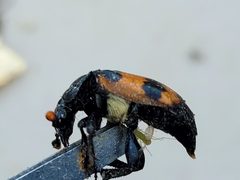
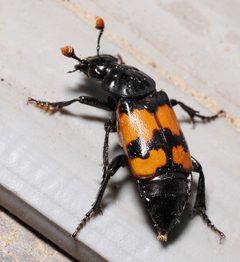
Medium-sized with the characteristic Nicrophorus body plan: robust, somewhat flattened, with clubbed . Coloration includes black with orange or red markings. The exhibits intermediate features between Nicrophorus marginatus and Nicrophorus guttula, particularly in pronotal coloration and elytral pattern. Antennae possess chemosensory structures for detecting carrion odors.
Habitat
Found in open including grasslands, prairies, and open woodlands. Occurs in areas where small vertebrate carcasses are available, including along roadways, in agricultural fields, and in natural grassland . Requires suitable substrate for burial of carcasses, typically loamy or sandy soils that permit excavation.
Distribution
Western and central North America. Canadian records from Alberta, British Columbia, Manitoba, Ontario, and Saskatchewan. United States records from Arizona, Colorado, Iowa, Idaho, Minnesota, Montana, North Dakota, Nebraska, New Mexico, Nevada, Oregon, South Dakota, Utah, Washington, and Wyoming.
Seasonality
Active during warmer months when carrion resources are available and soil conditions permit burial. likely overwinter in soil or protected locations. Peak activity has been observed from late spring through early autumn, with timing varying by latitude and elevation.
Diet
and larvae feed on small vertebrate carcasses, typically mammals and birds weighing 10-200 grams. Adults also consume carrion fly larvae that compete for the resource. Both parents regurgitate liquefied carrion to feed larvae.
Life Cycle
Complete with , larva, pupa, and stages. Adults locate carcasses using olfactory cues, bury them in soil, and prepare them by removing fur or feathers and shaping into a ball. Female lays eggs in soil near carcass. Larvae hatch in approximately four days, move to carcass, and are fed by both parents. Larvae mature in eight to nine days, then burrow into surrounding soil to pupate. Adults emerge after 48-60 days.
Behavior
Exhibits elaborate parental care rare among non-eusocial insects. Male-female pairs cooperate to locate, bury, and prepare carcasses. Both parents feed larvae through regurgitation. Parents may reduce size by consuming excess offspring when carcass resources are insufficient. apply oral and anal secretions containing antimicrobial compounds to carcass to slow decay and reduce competition from microbes and other scavengers. Males emit to attract females to carcasses.
Ecological Role
Primary consumer of small vertebrate carcasses, accelerating decomposition and nutrient cycling. Reduces risk by rapidly removing and interring carcasses. Antimicrobial secretions influence soil microbiome around burial sites. Serves as food source for vertebrate and . Competition with carrion beetles and flies structures dynamics around ephemeral resources.
Human Relevance
Contributes to services through carcass removal and nutrient cycling. No documented direct economic impact. May be encountered by entomologists and naturalists in field settings. Not known to be a pest or of human .
Similar Taxa
- Nicrophorus marginatusSimilar size and general appearance; N. hybridus shows intermediate between this and N. guttula, requiring careful examination of markings and genitalia for separation
- Nicrophorus guttulaOverlapping distribution and similar use; N. hybridus distinguished by less extensive orange pronotal coloration and intermediate elytral pattern
- Nicrophorus orbicollisBroadly sympatric in parts of range; differs in pronotal and elytral markings, with N. orbicollis typically showing more distinct patterns
More Details
Taxonomic History
Described in 1925 based on specimens showing intermediate characteristics between Nicrophorus marginatus and Nicrophorus guttula. The specific epithet 'hybridus' reflects this morphological intermediacy, though the is not of hybrid origin. The taxonomic status has been stable, with continued recognition as a valid species.
Family Placement
Nicrophorus hybridus is placed in Silphidae (carrion beetles) by most modern classifications, specifically in Nicrophorinae. Some older sources and databases (including GBIF) list Staphylinidae, reflecting historical taxonomic confusion or database errors; Silphidae is the currently accepted family placement.
Sources and further reading
- BugGuide
- Wikipedia
- GBIF taxonomy match
- iNaturalist taxon
- NCBI Taxonomy
- Congratulations, UC Davis Linnaean Games Team: National Champs! | Bug Squad
- Bohart Museum Spotlight on Yellow-Bellied Burying Beetles | Bug Squad
- They eat dead things - Part I - Burying beetles Silphidae — Bug of the Week
- Oklahoma is More than OK for Burying Beetles
- Burying Beetles Are Part of Nature's Clean-up Crew
- Bug Eric: Priocnemis minorata