
Omorgus punctatus
(Germar, 1823)
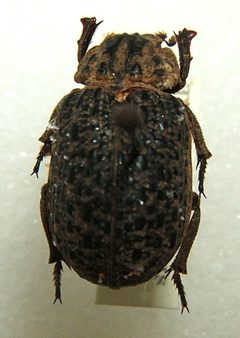
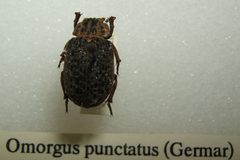
Omorgus punctatus is a of hide beetle in the Trogidae, distributed across the southwestern and central United States and northern Mexico. The species is associated with carrion and dry animal remains, typical of the family. are characterized by their punctured , which contributes to the species epithet 'punctatus'.

Pronunciation
How to pronounce Omorgus punctatus: /oˈmɔrɡus pʊŋkˈtaːtus/
These audio files are automatically generated. While they are not always 100% accurate, they are a good starting point.
Identification
Images
Appearance
Habitat
Arid and semi-arid environments including grasslands, scrublands, and desert margins. Associated with carrion and dry animal remains in open, sun-exposed .
Distribution
Nearctic: United States (Colorado, Iowa, Kentucky, Mississippi, Montana, Nebraska, Texas, Utah). Neotropical: Mexico (Aguascalientes, Baja California, Chihuahua, Coahuila, Durango, Guanajuato, Nuevo León, Sonora).
Diet
Carrion feeder; consumes dry animal remains and associated keratinous materials.
Life Cycle
Complete with , larval, pupal, and stages. Larvae develop in carrion or dry animal remains.
Behavior
are attracted to carrion and animal remains. Both adults and larvae feed on desiccated animal matter, with larvae typically remaining within the substrate.
Ecological Role
Decomposer; contributes to nutrient cycling by breaking down dry animal remains. Facilitates the removal of keratinous materials from the environment.
Human Relevance
Occasionally encountered in forensic contexts due to association with carrion. Not considered a pest .
Similar Taxa
- Omorgus suberosusOverlapping distribution in North America; differs in elytral punctation and pattern
- Trox spp.Similar (Trogidae) and ; distinguished by antennal club structure and body proportions
More Details
Taxonomic History
Originally described by Germar in 1823. The Omorgus was historically treated as a subgenus of Trox but has been elevated to full generic status based on morphological and molecular evidence.
Forensic Significance
Like other Trogidae, O. punctatus may colonize carrion in later stages of decomposition when remains have desiccated, potentially useful in for estimating postmortem intervals in dry environments.
Sources and further reading
- BugGuide
- Wikipedia
- GBIF taxonomy match
- iNaturalist taxon
- NCBI Taxonomy
- Bug Eric: Spider Sunday: Phidippus octopunctatus
- ID Challenge #18 | Beetles In The Bush
- Euonymus peril - Euonymus leaf notcher, Pryeria sinica — Bug of the Week
- Anne Arundel County - This Bug's for You: The Euonymus Leaf Notcher, Pryeria sinica — Bug of the Week
- Yet another exotic invader: Euonymus leaf notcher, Pryeria sinicia — Bug of the Week
- Bug of the Week