
Phanaeus adonis
Harold, 1863
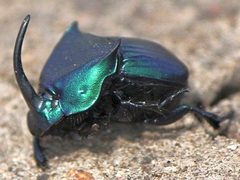
Phanaeus adonis is a true dung beetle in the Scarabaeidae, native to north-central Mexico with a limited range extending into far southern Texas. Like other members of the Phanaeus, it is associated with mammal , though specific behavioral details for this remain poorly documented. The species was described by Harold in 1863 and is part of the diverse Phanaeini tribe of colorful, often metallic dung beetles.
Pronunciation
How to pronounce Phanaeus adonis: /fəˈniːəs əˈdoʊnɪs/
These audio files are automatically generated. While they are not always 100% accurate, they are a good starting point.
Identification
Members of the Phanaeus are distinguished by their often brilliant metallic coloration and, in males, prominent cephalic horns used in combat and mate competition. Specific identification of P. adonis from requires examination of genitalic and other subtle morphological characters; the is part of a complex of similar forms in the Mexican highlands. Males typically bear larger and more elaborate horns than females, a common in the genus.
Images
Habitat
Found in temperate to subtropical regions of north-central Mexico, including states such as Guanajuato, Hidalgo, México, Michoacán, Morelos, Nuevo León, Querétaro, San Luis Potosí, Tamaulipas, and Veracruz. The occupies areas where suitable mammal sources and appropriate soil conditions for burrowing occur.
Distribution
Primary range covers north-central Mexico (Guanajuato, Guerrero, Hidalgo, México, Michoacán, Morelos, Nuevo León, Querétaro, San Luis Potosí, Tamaulipas, Veracruz). Peripheral occurrence in the Nearctic region: Cameron County, far southern Texas, United States.
Diet
Larvae feed on provisioned by in subterranean chambers. Specific mammal records for this are not documented, though the is broadly associated with large mammal dung.
Life Cycle
are deposited on within excavated underground chambers. Larvae consume the dung, complete development, pupate in chambers, and emerge as to seek fresh dung sources. Detailed timing and duration of stages are not documented for this .
Behavior
have been observed to excavate burrows near deposits and transport dung portions underground. As with other Phanaeus , cooperative between males and females in nest construction is probable but not specifically documented.
Ecological Role
Contributes to nutrient cycling and soil aeration through burial. Reduces dung accumulation on soil surface and may limit fly and parasitic breeding sites, as demonstrated for related in other regions.
Human Relevance
No direct economic importance documented. Like other dung beetles, provides services in pasture and rangeland environments through waste removal and soil enrichment.
Similar Taxa
- Phanaeus vindexSimilar metallic coloration and horned male ; distinguished by geographic distribution (primarily eastern and central United States) and subtle structural differences
- Phanaeus difformisOverlaps in Texas distribution; requires careful examination of male horn structure and color patterns for separation
More Details
Taxonomic note
The was described by Edgar von Harold in 1863. The specific epithet 'adonis' references the beautiful youth of Greek mythology, presumably alluding to the species' attractive appearance.
Sources and further reading
- BugGuide
- Wikipedia
- GBIF taxonomy match
- iNaturalist taxon
- Catalogue of Life
- From the Bug of the Week mailbag a rainbow arrives to preserve our air from “The Infection of Dungs”: Rainbow dung beetle, Phanaeus vindex — Bug of the Week
- Preserve our air from “The Infection of Dungs”: Rainbow dung beetle, Phanaeus vindex — Bug of the Week
- Preserve our air from “The Infection of Dungs”: Rainbow dung beetle, Phanaeus vindex — Bug of the Week
- Curculionidae | Beetles In The Bush | Page 2
- Cover Photo—The Coleopterists Bulletin 71(4) | Beetles In The Bush
- Cover Photo—The Coleopterists Bulletin 67(3) | Beetles In The Bush