
Phanaeus vindex
MacLeay, 1819
Rainbow Scarab, Rainbow Dung Beetle
Phanaeus vindex is a medium-sized tunneling dung beetle native to eastern and central North America. are sexually dimorphic and exhibit striking metallic coloration, with males bearing a prominent curved horn. The creates complex underground tunnel systems beneath deposits, constructing both balls for and food caches for adult feeding. It is the most widespread Phanaeus species in the United States and demonstrates behavioral plasticity in response to temperature, adjusting burial depth of food caches under warmer conditions. The species provides important services through dung removal, nutrient cycling, and secondary seed .

Pronunciation
How to pronounce Phanaeus vindex: /fəˈniːəs ˈvɪndɛks/
These audio files are automatically generated. While they are not always 100% accurate, they are a good starting point.
Identification
Distinguished from similar Phanaeus by its widespread distribution across eastern and central North America. Males are easily recognized by the large backward-curving horn and brilliant metallic coloration. Females lack horns and have duller coloration. The species may hybridize with the less common P. difformis where ranges overlap. Separated from other dung beetles by the combination of: paracoprid tunneling below , clay-encased balls, and the distinctive metallic rainbow coloration.
Images
Appearance
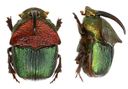
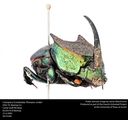
are hard-bodied, relatively bulky, oblong beetles ranging from 11–22 mm in length. Sexually dimorphic: males possess iridescent and a large horn on the that curves backward toward the , while females have slightly less vibrant shells and lack horns. The head is metallic yellow; the thorax is shiny coppery with yellow or green on the sides. Yellow can retract into a ball on the underside of the head. Males occur in two morphs: major morph with large horns and bodies, and minor morph with significantly reduced horn and body size. Female have more segments than males and do not raise above the elytra as in males.
Habitat
Occupies diverse including pastures, grasslands, and forested areas across its range. Demonstrates wide habitat and ability to occupy various soil types, though prefers clay soils over sandy substrates. Found in pinyon-oak-juniper woodland, mesquite chaparral, and agricultural landscapes with livestock. In southeastern Michigan, occurs on small- cattle farms with cool-season grasses and loamy soils. Requires presence of mammal for and feeding.
Distribution
Native to North America. Found in eastern and central United States from Florida and New England west to Arizona and Wyoming, and in northern Mexico (Chihuahua). Most widespread Phanaeus in the United States. Northern range limit extends to southeastern Michigan. GBIF records document presence in 30 US states plus Vermont.
Seasonality
Active during warmer months; in Florida, have been observed in pool filters as late as January, suggesting year-round activity in subtropical regions. In temperate areas, adults overwinter below the frost line in tunnel networks and emerge when temperatures increase. Mark-recapture studies document individual lifespans up to 338 days, indicating potential for year-to-year overlap in adult .
Diet
Obligate coprophage; feeds exclusively on fecal excrement through all life stages. Strongly prefers from omnivores such as pigs and cows, will consume herbivore dung, and is least attracted to dung. Attracted to "fragrant" excrement from organisms with diverse diets. create food caches—loosely packed dung masses buried at shallower depths than balls—for adult feeding. Larvae consume dung within brood balls.
Life Cycle
Complete with , larval, pupal, and stages. Fertilized females can store seminal fluid and independently create two types of deposits: balls (round, clay-encased, containing eggs for ) and food caches (for adult feeding). Brood balls buried at average depths around 25 cm (range 5–40 cm). Larvae hatch after a few days and consume nutrient-rich dung within brood balls. Development from egg to adult spans approximately 2–6 months. Entire lifespan less than one year, though individuals may live up to 338 days in cold-temperate climates. Adults overwinter below frost line in tunnel networks.
Behavior
Exhibits complex paracoprid nesting : tunnels beneath piles to create underground chambers and tunnel networks. Both sexes cooperate to excavate burrows, transport dung, and construct balls. Females perform "butting" motions to push dung when forming brood balls. Males fight to maintain exclusive access to females at burrows. Demonstrates behavioral plasticity in response to temperature: under experimental warming (+2.1°C), buries food caches deeper while brood ball depth remains unchanged. Tends to dig vertically rather than creating diagonal tunnels. Protects brood balls with cement-like layer of dung.
Ecological Role
Primary service: removal and nutrient cycling through burial of animal waste into subterranean galleries, enhancing soil microbial and accelerating nutrient mineralization. Secondary seed disperser (endozoochory): buries seed-containing dung, moving seeds away from original dung source underground, potentially facilitating escape from seed and and providing suitable locations for plant germination. Reduces for intestinal worms, , and . Contributes to bioturbation. Climate-induced behavioral shifts in burial depth can alter seed fate and plant-animal interactions with ramifications for plant recruitment and ecosystem functioning.
Human Relevance
Highly beneficial for agriculture and public health through removal of livestock . Reduces greenhouse gas from above-ground dung decomposition. Historically noted in colonial Maryland (1600s) for its role in preserving air quality by removing dung. Can be readily bred in captivity for research. Subject of successful programs in Australia using related dung beetle to address cattle dung accumulation. Occasionally observed in residential areas, where it may be encountered on decks or in pool filters.
Similar Taxa
- Phanaeus difformisOverlapping range with potential for hybridization; generally less common than P. vindex
- Canthon spp.Co-occurring dung beetles that roll rather than tunnel; smaller size, different body form
- Other Phanaeus speciesMore restricted distributions; P. vindex is the most widespread Phanaeus in the United States
More Details
Male Dimorphism
Males occur in two distinct morphs: major morphs possess large horns and larger bodies, while minor morphs have significantly reduced horns and smaller bodies. Both morphs are reproductively active.
Parasite Exposure
Due to feeding on fecal matter, P. vindex is exposed to such as the Physocephalus sexalatus. Infected individuals consume approximately half as much , dig shorter tunnels, move less dung, and produce fewer offspring.
Iteroparity
Females are , capable of multiple reproductive events in a lifetime with multiple males. Females exhibiting higher tend to select males likely to invest more in offspring care.
Temperature-Dependent Behavior
Research demonstrates that females alter reproductive based on temperature: in warmer climates, they produce more balls and bury them deeper to buffer offspring from heat, though this reduces brood ball size and may affect offspring nutrition.
Sources and further reading
- BugGuide
- Wikipedia
- GBIF taxonomy match
- iNaturalist taxon
- NCBI Taxonomy
- Catalogue of Life
- From the Bug of the Week mailbag a rainbow arrives to preserve our air from “The Infection of Dungs”: Rainbow dung beetle, Phanaeus vindex — Bug of the Week
- I’m a fun guy! | Beetles In The Bush
- Archive — Bug of the Week
- Scathophagidae | Beetles In The Bush
- Preserve our air from “The Infection of Dungs”: Rainbow dung beetle, Phanaeus vindex — Bug of the Week
- Preserve our air from “The Infection of Dungs”: Rainbow dung beetle, Phanaeus vindex — Bug of the Week
- Impacts of warmer temperatures on secondary seed dispersal by Phanaeus vindex dung beetles (Scarabaeinae).
- Population structure of Phanaeus vindex (Coleoptera: Scarabaeidae) in SE Michigan.