
Digitonthophagus gazella
(Fabricius, 1787)
Gazelle scarab, Brown dung beetle
Digitonthophagus gazella is a dung beetle native to Afro-Asian regions that has been widely introduced across the Americas, Australia, and Pacific islands for of cattle . The exhibits rapid ability due to high reproductive rates, opportunistic resource utilization, and strong capacity. It has become established in numerous tropical and subtropical regions, with documented naturalized in North, Central, and South America. The species shows complex nesting involving tunnel construction by both sexes and has been extensively studied for its ecological impacts on native dung beetle .


Pronunciation
How to pronounce Digitonthophagus gazella: //ˌdɪdʒɪtɒnˈθɒfəɡəs ɡəˈzɛlə//
These audio files are automatically generated. While they are not always 100% accurate, they are a good starting point.
Identification
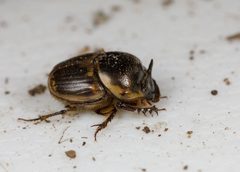
Small to medium-sized dung beetle with brown coloration. Distinguished from native New World dung beetles by its Afro-Asian origin and established introduced status across the Americas. The Digitonthophagus was elevated from subgenus status in 1959, though confusion persists with the outdated name Onthophagus gazella. Males and females both participate in nest construction, with measurable in body size and horn development. Introduced show significant phenotypic variation in size and shape compared to native African populations.
Images
Habitat
Open including pastures, grasslands, and agricultural landscapes. Strongly associated with cattle ranching systems. In its native range, occupies savanna and grassland . Shows limited penetration into forested habitats; in northern Colombia, it was observed to remain outside of tropical dry forest boundaries. Prefers open, sun-exposed environments where mammalian accumulates.
Distribution
Native to Afro-Asian region including sub-Saharan Africa, India, Sri Lanka, and parts of the Middle East. Introduced to North America (first in 1972, now established in southern USA including Texas, Arizona, Florida, Colorado, Hawaii), Central America, South America (Brazil, Colombia, Bolivia, Chile, Peru, Venezuela, and others), Australia (introduced 1968), and Pacific islands (Fiji, New Caledonia, Vanuatu, Papua New Guinea). Climate modeling indicates it has largely reached its predicted maximum distribution in North America.
Seasonality
Activity patterns tied to rainfall and temperature. In arid northern Mexico, triggered by heavy thundershowers that reconstitute dried . In Brazilian Cerrado-Pantanal transition zone, abundance reduced by high humidity while temperature positively affects male abundance. Year-round activity in tropical regions; in temperate introduced ranges, limited by cold and mortality.
Diet
Specialized coprophage feeding on mammalian , with strong preference for bovine dung. Does not utilize carrion, fungus, or fruit. process substantial quantities of cattle dung, burying portions for larval provisioning.
Life Cycle
Complete with development period of approximately 31 days under laboratory conditions. Progresses through , three larval instars, pupa, and . Both male and female participate in parental care through nest construction. Tunnel length and depth increase time-dependently during nesting period (measured at 14.7 cm, 16.9 cm, and 19.8 cm on days 10, 20, and 30; depths of 9.8 cm, 12.9 cm, and 13.5 cm respectively).
Behavior
Exhibits complex tunnel-making with time-dependent increases in tunnel dimensions. Both sexes participate in nest construction, indicating biparental care. activity to ultraviolet light sources observed. Shows aggregated spatial distribution around resources at low, medium, and high densities. Intraspecific likely driven by immigration preferences toward repeatedly selected dung patches and patches with higher initial numbers. Exhibits differential rates that drive microspatial segregation from competing introduced like Euoniticellus intermedius.
Ecological Role
Primary decomposer accelerating degradation of cattle dung on pastures. Reduces for flies and gastrointestinal of livestock. Provides economic benefits through reduced agrochemical use in cattle systems. potential alters native dung beetle structure; associated with lower abundance of endocoprid native in Brazilian pastures. Can outcompete similar species and potentially alter functions including nutrient cycling. Considered naturalized with minimal impact in some regions where it does not penetrate forests or exclude native species through competition.
Human Relevance
Introduced deliberately across multiple continents for pasture improvement and . Part of Australian Dung Beetle Project (1968) and similar programs in the Americas. Reduces cattle accumulation, fly breeding sites, and transmission. Subject of extensive research on invasion , bioclimatic modeling, and ecological impacts. Used in studies of modulation of insect . Toxicological research subject for effects on beneficial insects.
Similar Taxa
- Onthophagus taurusBoth are introduced dung beetles in North America used for pasture improvement; O. taurus is European in origin and shows greater cold with potential for northern range expansion
- Onthophagus nuchicornisEuropean introduced dung beetle established across Canada; used as positive control in comparative development studies with D. gazella
- Euoniticellus intermediusAnother introduced dung beetle showing microspatial segregation with D. gazella through differential rates in shared
Sources and further reading
- BugGuide
- Wikipedia
- GBIF taxonomy match
- iNaturalist taxon
- NCBI Taxonomy
- Catalogue of Life
- Scarabaeidae | Beetles In The Bush | Page 4
- I Brake for Dung Beetles! | Beetles In The Bush
- conservation | Beetles In The Bush | Page 5
- Miridae | Beetles In The Bush
- Digitonthophagus Gazella (Coleoptera: Scarabaeidae): Distribution in America and Two New Records for Colombia
- First report on the distribution of digitonthophagus gazella (fabricius, 1787) (coleoptera: scarabaeidae) in Bolivia
- Elucidating the role of neurotransmitters in the nesting behaviour of Digitonthophagus gazella (Fabricius, 1787) (Coleoptera: Scarabaeidae)
- Toxic effects of deltamethrin on oxidative stress, behavioural, organosomatic indices and histopathological changes in Digitonthophagus gazella (Coleoptera: Scarabaeinae)
- Effect of Digitonthophagus gazella on taxonomic diversity and functional traits of native dung beetles in Brazilian introduced pastures
- Is <i>Digitonthophagus gazella</i> undergoing a naturalization process? A study case in a tropical dry forest of northern Colombia ¿Está Digitonthophagus gazella en proceso de naturalización? Estudio de caso en un bosque seco tropical del norte de Colombia
- SPATIAL MICRODISTRIBUTION OF TWO INTRODUCED DUNG BEETLE SPECIES DIGITONTHOPHAGUS GAZELLA (F.) AND EUONITICELLUS INTERMEDIUS (REICHE) (COLEOPTERA SCARABAEIDAE) IN AN ARID REGION OF NORTHERN MEXICO (DURANGO, MEXICO)
- Examining phenotypic variations in an introduced population of the invasive dung beetle Digitonthophagus gazella (Coleoptera: Scarabaeidae)
- Bioclimatic analyses for the distributions ofOnthophagus nuchicornis,Onthophagus taurus, andDigitonthophagus gazella(Coleoptera: Scarabaeidae) in North America
- Degree-day models for development of the dung beetlesOnthophagus nuchicornis,O. taurus, andDigitonthophagus gazella(Coleoptera: Scarabaeidae), and the likelihood ofO. taurusestablishment in southern Alberta, Canada