
Euoniticellus intermedius
(Reiche, 1850)
Northern Sandy Dung Beetle
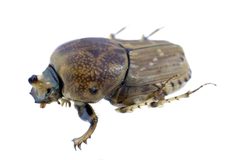
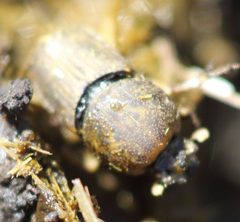
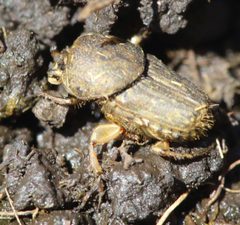
Euoniticellus intermedius is an African dung beetle intentionally introduced to multiple continents for burial and livestock pest control. Males possess a distinctive horn absent in females, making it a model organism for studies. The exhibits remarkable to diverse environments and stressors, though it is sensitive to global change factors including warming and pollution. Larvae feed exclusively on cow dung fiber while consume juices from fresh dung.
Pronunciation
How to pronounce Euoniticellus intermedius: /juːˌɑnɪˈtɪsələs ɪntərˈmiːdiəs/
These audio files are automatically generated. While they are not always 100% accurate, they are a good starting point.
Images
Habitat
Cow environments; associated with cattle pastures and dung deposition sites. Successfully colonizes diverse latitudes and elevations beyond native range.
Distribution
Native to Africa (Afrotropical region including South Africa, Angola, Ethiopia, Ghana, Ivory Coast, Mozambique, Senegal, Somalia). Introduced and established in North America (USA: Texas), Central America ( Rica, El Salvador, Guatemala, Honduras, Mexico, Nicaragua, Panama), and Oceania (Australia). Also recorded from Palaearctic region (Arabian Peninsula, southern Italy).
Diet
Larvae feed solely on cow , eating and digesting fiber material. live on juices found in fresh dung.
Life Cycle
Late second to third instar larvae possess gut micro-flora with cellulolytic activity (endo-glucanase and cellobiohydrolase) enabling digestion of cellulose in material. Gut structure consists of small with distinct and chambers where dung processing occurs.
Behavior
Exhibits aggregated spatial distributions at low, medium, and high densities. Intraspecific likely driven by immigration preferences toward repeatedly selected pats and those with higher initial individual counts. Shows differential rates depending on arrival numbers rather than .
Ecological Role
Primary decomposer contributing to nutrient cycling in cattle pastures. Potential source of cellulolytic microorganisms and for cellulose-derived biofuel production. Buries cattle dung, reducing pest and facilitating nutrient return to soil.
Human Relevance
Intentionally introduced globally for of livestock pests through burial. Used extensively as model organism in evolutionary (), ecotoxicology (responses to contaminants), and physiological research. Sensitive to veterinary pharmaceutical residues in dung, particularly cypermethrin pour-ons which cause 80-100% mortality at 2-7 days post-treatment, though spray show reduced .
Similar Taxa
- Digitonthophagus gazellaCo-occurs as introduced dung beetle in American range; shows negative spatial correlation with E. intermedius in arid regions of Mexico due to differential rates rather than direct competition
More Details
Sexual Dimorphism
Males possess a horn correlated with individual condition and strength; females lack this structure, making the a key model for research.
Global Change Sensitivity
Despite broad environmental , the is sensitive to warming and pollution conditions associated with global change.
Veterinary Drug Interactions
Cypermethrin pour-on cause severe mortality (80-100%) in 2-7 days post-treatment; flumethrin pour-ons and cypermethrin spray formulations show minimal effects, highlighting formulation-specific differences.
Sources and further reading
- BugGuide
- GBIF taxonomy match
- iNaturalist taxon
- NCBI Taxonomy
- Catalogue of Life
- Encyrtid Holdings | Entomology Research Museum
- Bembicid Holdings | Entomology Research Museum
- Captive-bred population could save endangered crocodile from extinction
- Bug Eric: The Tarantula Hunt
- 9th Annual Fall Tiger Beetle Trip: Day 1 | Beetles In The Bush
- Botanizing (again!) at Victoria Glades Conservation Area | Beetles In The Bush
- The Reproductive Biology of Euoniticellus intermedius (Reiche) (Coleoptera: Scarabaeinae: Oniticellini)
- Cellulolytic Activities of the Dung Beetle, Euoniticellus Intermedius, Larva Gut Micro-Flora
- Euoniticellus intermedius (Coleoptera: Scarabaeidae): Description of Adults and Immatures and Biology of Adults
- Physiology, ecology, and evolution of a successful colonizer: the horned dung beetle, Euoniticellus intermedius
- Lifestyle and Host Defense Mechanisms of the Dung Beetle,Euoniticellus intermedius: The Toll Signaling Pathway
- SPATIAL MICRODISTRIBUTION OF TWO INTRODUCED DUNG BEETLE SPECIES DIGITONTHOPHAGUS GAZELLA (F.) AND EUONITICELLUS INTERMEDIUS (REICHE) (COLEOPTERA SCARABAEIDAE) IN AN ARID REGION OF NORTHERN MEXICO (DURANGO, MEXICO)
- Survival and reproduction ofEuoniticellus intermedius(Coleoptera: Scarabaeidae) in dung following application of cypermethrin and flumethrin pour-ons to cattle
- Effects of cattle treatment with a cypermethrin/cymiazol spray on survival and reproduction of the dung beetle species Euoniticellus intermedius (Coleoptera: Scarabaeidae)
- Effects of cattle treatment with a cypermethrin/cymiazol spray on survival and reproduction of the dung beetle species <I>Euoniticellus intermedius</I> (Coleoptera: Scarabaeidae)