
Onthophagus taurus
(Schreber, 1759)
taurus scarab, bull-headed dung beetle
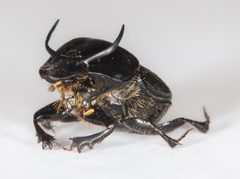
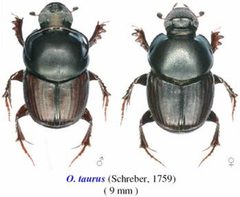
Onthophagus taurus is a tunneling dung beetle native to Mediterranean regions of Europe, Asia Minor, and North Africa. The exhibits pronounced and male : large "major" males develop long curved horns used in combat, while small "minor" males remain hornless and employ sneaking tactics to access females. Females lack horns entirely. Both sexes cooperate in biparental care, constructing underground chambers where is packed into brood balls for larval development. The species has been introduced to the United States and Australia for agricultural biocontrol of cattle dung.
Pronunciation
How to pronounce Onthophagus taurus: /ɒnˈθɒfəɡəs ˈtɔːrəs/
These audio files are automatically generated. While they are not always 100% accurate, they are a good starting point.
Identification
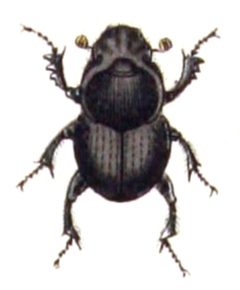
Males are immediately recognizable by the presence of horns in large individuals—long, sweeping, curved structures resembling those of a longhorn bull—while small males and all females are hornless. Body size is 8–10 mm. Coloration is typically black or reddish brown, sometimes with a weak metallic sheen on the pronotum. The oval body shape and association with cattle pads distinguish it from similar Onthophagus , though precise identification may require examination of genitalia or other subtle morphological features.
Images
Habitat
Native to regions with Mediterranean climate; most abundant in grassland where cattle are present. In introduced ranges, occupies pastures and agricultural lands with mammalian availability. Optimal development occurs between 16 °C and 23 °C; reproductive success is limited in cold regions.
Distribution
Native to central and southern Europe, Asia Minor, and North Africa, ranging from Spain and Morocco eastward through Turkey, Syria, Iraq, Iran, Afghanistan, and Central Asia. Introduced to the United States (first detected in Florida in 1971, now established from Florida to Michigan and westward to California and Texas) and Australia (introduced 1974, now prevalent in southwestern Australia). Also present in New Zealand (released 2013).
Diet
Specializes in cattle ; feed on fresh dung. Larvae develop within balls constructed from packed dung.
Sources and further reading
- BugGuide
- Wikipedia
- GBIF taxonomy match
- iNaturalist taxon
- NCBI Taxonomy
- Catalogue of Life
- By Recycling Leftover Genes, Beetles Make New Horns and Eyes
- Is This Non-Native Mason Bee an Invasive Species?
- Battles Beneath the City Park: What Urban Dung Beetles Reveal About Sexual Selection
- dung beetle | Blog
- European Mason Bee Lands in North America's Pacific Northwest, Likely to Spread
- How to Make a Four-Eyed Beetle
- Gene discovery in the horned beetle Onthophagus taurus
- Behavioural dynamics of biparental care in the dung beetle Onthophagus taurus
- Intraspecific female brood parasitism in the dung beetle Onthophagus taurus
- Allometric relationships and character evolution inOnthophagus taurus(Coleoptera: Scarabaeidae)
- Westward Expansion of Onthophagus taurus (Schreber) (Coleoptera: Scarabaeidae): Current Distribution of a Non-Native Species
- Bioclimatic analyses for the distributions ofOnthophagus nuchicornis,Onthophagus taurus, andDigitonthophagus gazella(Coleoptera: Scarabaeidae) in North America
- A cost of maternal care in the dung beetle Onthophagus taurus?
- Ecological Role of <i>Onthophagus taurus</i> (Schreber) in Soil Nutrient Mobilization
- Acclimation to thermal variability increases the intensity of activity and alters the activity window in the temperate dung beetle Onthophagus taurus
- Adult sex ratio influences courtship behaviour, contest behaviour and breeding success in Onthophagus taurus
- Degree-day models for development of the dung beetlesOnthophagus nuchicornis,O. taurus, andDigitonthophagus gazella(Coleoptera: Scarabaeidae), and the likelihood ofO. taurusestablishment in southern Alberta, Canada
- Confidence of paternity and paternal care: covariation revealed through the experimental manipulation of the mating system in the beetle Onthophagus taurus
- Comparative metabolomic analysis of polyphenic horn development in the dung beetle Onthophagus taurus