
Plectris aliena
Chapin, 1934
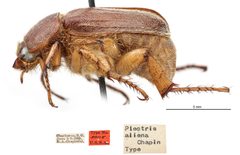
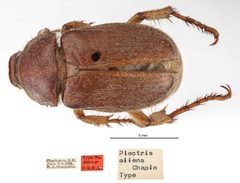
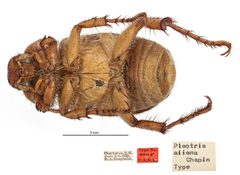
Plectris aliena is a scarab beetle first described by Chapin in 1934. measure 10.8–13.5 mm in length and exhibit a castaneous to yellowish-brown coloration above with paler undersides and legs. The species has been documented across a remarkably broad geographic range spanning three continents: South America (Argentina, Brazil, Paraguay), North America (North Carolina, South Carolina), and Australia (New South Wales).
Pronunciation
How to pronounce Plectris aliena: //ˈplɛk.trɪs əˈliː.nə//
These audio files are automatically generated. While they are not always 100% accurate, they are a good starting point.
Identification
Distinguished from similar scarab beetles by the combination of: coarsely and densely punctured (vs. more finely punctured in related ); pronotum more finely and sparsely punctured than clypeus; with four indistinct and fine punctures each bearing a -like hair; and the overall castaneous to yellowish-brown coloration. The disjunct distribution across three continents may also aid in identification, though this requires confirmation of native vs. introduced .
Images
Appearance
are 10.8–13.5 mm in length. The surface is castaneous to yellowish brown, while the surface and legs are paler. The is coarsely and densely punctured. The pronotum surface is more finely and much more sparsely punctured than the clypeus. The bear four indistinct with fine, not very densely placed punctures, each containing a -like hair.
Distribution
Native or established recorded from Argentina, Brazil (Mato Grosso do Sul), and Paraguay in South America; North Carolina and South Carolina in the United States; and New South Wales in Australia. The ' presence on three continents suggests either a naturally broad range or human-mediated , though the origin status in each region remains to be confirmed.
Similar Taxa
- Other Plectris speciesShare -level characteristics of body form and general scarab ; distinguished by specific punctation patterns on and pronotum, and elytral development.
- Macrodactylini tribe membersSimilar overall body plan and size range; require examination of genitalia and detailed punctation patterns for definitive separation.
More Details
Taxonomic note
The broad, disjunct distribution across South America, North America, and Australia is unusual for a scarab beetle and warrants further investigation to determine whether all represent the same or if cryptic species are involved. The Australian and North American records may represent introductions.
Data gaps
Larval , , and associations are unknown. The ' native range has not been definitively established.
Sources and further reading
- BugGuide
- Wikipedia
- GBIF taxonomy match
- iNaturalist taxon
- Catalogue of Life
- Why You Should Celebrate World Robber Fly Day | Bug Squad
- What Does It Take to Detect Long-Term Insect Abundance Trends?
- Extension Unplugged: Communicating Entomology to Amish and Mennonite Communities in Pennsylvania
- How art can amplify subterranean science
- Bug Eric: Spooders and Noodles