
Euetheola rugiceps
(LeConte, 1856)
Sugarcane Beetle
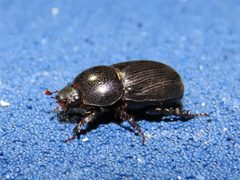
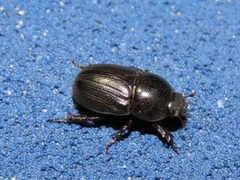
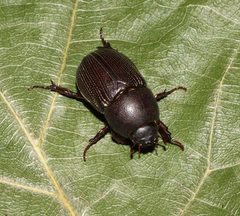
Euetheola rugiceps, commonly known as the sugarcane , is a scarab beetle in the Scarabaeidae. It is a sporadic but serious pest of corn in parts of Texas, where damage to young plants by overwintered can result in plant death, stunting, or lodging. The has one per year, with adults emerging from soil in spring and late summer to early fall. It is also known to damage sugarcane and other grass crops. The beetle is distributed across the eastern and central United States.
Pronunciation
How to pronounce Euetheola rugiceps: /ju.ɛˈθiː.oʊ.lə ˈruː.dʒɪ.sɛps/
These audio files are automatically generated. While they are not always 100% accurate, they are a good starting point.
Identification
can be distinguished from other black scarab beetles by their robust, heavily armored appearance and association with corn and grass crops. Larvae are identified by the red capsule and C-shaped white form. The is most likely to be confused with other white grub species (Phyllophaga spp., Cyclocephala spp.), but adults of E. rugiceps are more heavily armored and have a distinctive to dull black coloration. Confirmation may require examination of the and other mouthpart structures.
Images
Habitat
Found in agricultural fields, particularly corn and sugarcane, as well as grass pastures and sod. burrow in soil and typically remain below the surface. Larval development occurs entirely below the soil surface in association with plant roots and decaying organic matter. Preferred -laying sites are grass pastures and sod; corn is relatively unattractive for oviposition.
Distribution
Eastern and central United States: Alabama, Arkansas, Delaware, District of Columbia, Florida, Georgia, Illinois, Indiana, Iowa, Kansas, Kentucky, Louisiana, Maryland, Mississippi, Missouri, Nebraska, New Jersey, North Carolina, Ohio, Oklahoma, Pennsylvania, South Carolina, Tennessee, Texas, Virginia, West Virginia, and Wisconsin. In Texas, it is a sporadic pest in corn-growing regions, particularly where corn is planted adjacent to pasture or grassland.
Seasonality
emerge from soil in spring as soil temperatures rise, with peak activity of in April and May (based on light trap studies in Louisiana). Adults are active through late summer to early fall. Larval development occurs over summer. Adults enter dormancy as soil temperatures decline below 50°F in fall and winter, burrowing deeper into soil.
Diet
feed on the main stem of corn plants at soil depth of 0.5–1.0 inch, causing damage to the crown area. Larvae feed on decaying plant matter in soil; specific larval plants are not well documented but likely include grass roots.
Host Associations
- Zea mays - pestPrimary agricultural ; damage seedling to V5 stage corn by burrowing and feeding on main stem
- Saccharum officinarum - pest derives from association with sugarcane; damage patterns similar to corn
- grass pastures - breedingPreferred oviposition sites; larvae develop in soil associated with grass roots
Life Cycle
One per year. emerge from soil in spring, mate, and begin -laying shortly thereafter. Eggs are laid near or in contact with plants and hatch in 8–10 days. Larval development occurs below soil surface over 50–60 days, with three instars. occurs in soil, lasting approximately 16 days. New adults emerge in late summer to early fall, may feed briefly, then burrow deeper into soil to overwinter as temperatures decline.
Behavior
are strong fliers and can readily move from pasture and grassland areas into corn fields. They are or cryptic, typically remaining below the soil surface during the day. Adults may come to the surface to feed. into fields occurs overnight, making monitoring difficult—first sign of presence is usually plant damage rather than observed beetles. Adults enter dormancy when soil temperatures drop below 50°F.
Ecological Role
Larvae contribute to soil organic matter decomposition through feeding on decaying plant material. As a crop pest, the can significantly reduce plant stands and yield in affected fields. serve as prey for soil-dwelling and birds, though specific predator relationships are not well documented.
Human Relevance
Economic pest of corn and sugarcane. Damage to seedling corn can result in stand loss, stunting, lodging, goosenecking, suckering, dead , or plant death. Yield reductions or replanting costs can reach 30 percent in heavily infested fields. Control is challenging due to subterranean feeding habit; curative treatments are generally ineffective. Preventative at-planting treatments are recommended in fields with history of . No established exist. Limited insecticide options are labeled for this pest.
Similar Taxa
- Phyllophaga spp. (May/June beetles)Similar white larvae and robust scarab form; distinguished by adult activity period (May/June beetles active later in spring/summer) and less heavily armored adult appearance
- Cyclocephala spp. (masked chafers)Similar larval form and ; typically smaller, more active at night, with distinctive markings on pronotum
- Popillia japonica (Japanese beetle)Similar scarab and larval form; distinctly different with metallic green and coloration, and larvae have characteristic V-shaped raster pattern
More Details
Management Challenges
The sugarcane is particularly difficult to manage because feed below the soil surface on the plant crown, making contact ineffective unless applied preventatively at planting. Most universities do not recommend rescue treatments. Georgia and Tennessee Extension guides suggest directed sprays may be attempted when stand loss reaches 5–10 percent, but acknowledge these are generally ineffective.
Cultural Control
Early planting may allow corn to escape peak periods while in vulnerable early growth stages. Crop away from corn is not always effective because adults can fly in from adjacent pasture or grassland. Maintaining weed-free fields may reduce alternative .