
Strategus antaeus
(Drury, 1773)
ox beetle, smooth ox beetle
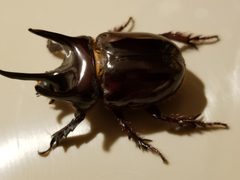
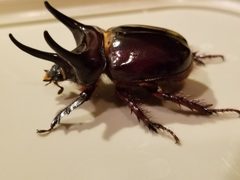
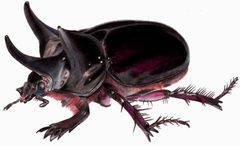
Strategus antaeus, commonly known as the ox beetle or smooth ox beetle, is a large rhinoceros beetle in the Scarabaeidae. It is the second largest in eastern North America. The occurs in xeric sand prairie remnants and is associated with oak trees, particularly Quercus marilandica (post oak). Live individuals are rarely encountered; carcass remnants are typically found at the base of trees.
Pronunciation
How to pronounce Strategus antaeus: /strəˈtiːɡəs ænˈtiːəs/
These audio files are automatically generated. While they are not always 100% accurate, they are a good starting point.
Identification
Distinguished from other Strategus by its smooth, relatively unornamented pronotum lacking prominent or horns in females and minor males. Super-major males possess enlarged and pronotal horns. Large body size distinguishes it from most sympatric scarabs. Carcass remnants found under oaks in sand prairie are characteristic sign of presence.
Images
Habitat
Xeric sand prairie remnants, particularly at the perimeter of sand blowout areas. Associated with oak trees (Quercus spp., especially Q. marilandica/post oak) that ring sand blowout perimeters.
Distribution
Eastern and central United States. Documented from Alabama, Arkansas, Connecticut, Delaware, Florida, Georgia, Kansas, Kentucky, Louisiana, Maryland, Massachusetts, Mississippi, New Jersey, New York, North Carolina, Oklahoma, Pennsylvania, Rhode Island, South Carolina, Tennessee, Texas, and Virginia. First documented in Missouri at Sand Prairie Conservation Area in southeastern Missouri.
Host Associations
- Quercus marilandica - associated withpost oak; carcass remnants found at base of trees in sand prairie
Behavior
activity inferred from typical dynastine habits. Live individuals rarely observed; presence typically detected through carcass remnants found under oaks.
Human Relevance
Subject of entomological interest due to large size and rarity of live encounters. Missouri state record represents significant range extension discovery.
Similar Taxa
- Strategus aloeusSimilar large size and preferences; distinguished by pronotal ornamentation patterns
- Dynastes tityusAnother large eastern dynastine; distinguished by different horn configuration and smoother