
Euphoria sepulcralis
(Fabricius, 1801)
Dark Flower Scarab
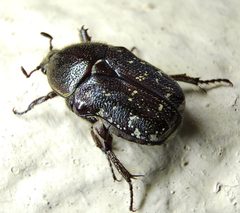
Euphoria sepulcralis, commonly known as the Dark Flower Scarab, is a small flower chafer (Cetoniinae) measuring 9–11 mm in length. It is widespread across the eastern and central United States, extending into Mexico. are active during daylight hours and are frequently observed on flowers, particularly goldenrod, as well as at sap flows on trees. The exhibits a distinctive dark brown to black coloration that distinguishes it from its more brightly colored . It is one of the most commonly encountered Euphoria species in its range and has been documented feeding on roses as larvae.


Pronunciation
How to pronounce Euphoria sepulcralis: /juːˈfɔːriə sɛˌpʌlˈkreɪlɪs/
These audio files are automatically generated. While they are not always 100% accurate, they are a good starting point.
Identification
Euphoria sepulcralis can be distinguished from similar flower scarabs by its dark brown to black coloration, contrasting with the metallic green, blue, or reddish hues typical of such as E. fulgida and E. kernii. The measures 9–11 mm in length. It lacks the bright metallic pronotum and patterned seen in many other Euphoria species. When disturbed, may raise their hind legs in a defensive posture that has been suggested to mimic the of a .
Images
Habitat
Occurs in diverse across its range, including sand prairies, mesquite chaparral, pinyon-oak-juniper woodland, and bottomland forests. are frequently found in association with flowering vegetation, particularly in open or edge habitats.
Distribution
Widespread in North America from Ontario and Quebec south to Florida, west to Nebraska, Colorado, and New Mexico. Also recorded from the Bahamas, Cayman Islands, and throughout Mexico including Chiapas, Chihuahua, Colima, Distrito Federal, Durango, Guanajuato, Guerrero, Hidalgo, Jalisco, México, Michoacán, Morelos, Nayarit, Nuevo León, Oaxaca, Puebla, Sonora, Tamaulipas, Veracruz, and Yucatán.
Seasonality
are most commonly encountered from late spring through fall, with peak activity during summer months. In Missouri, adults have been recorded in jug traps from mid-July through August.
Diet
feed on nectar and pollen from flowers, with documented occurrences on goldenrod (Solidago), Anne's lace (Daucus carota), American feverfew (Parthenium integrifolium), New Jersey tea (Ceanothus americanus), wild hydrangea (Hydrangea arborescens), hairy mallow (Hibiscus lasiocarpos), and sap flows on trees. Larvae feed on decaying organic matter including manure and compost; a record exists for Rosa (rose).
Host Associations
- Rosa - larval Documented larval feeding on rose roots.
- Solidago - food source frequently observed on goldenrod flowers.
- Daucus carota - food source observed on Anne's lace.
- Parthenium integrifolium - food source observed on American feverfew.
- Ceanothus americanus - food source observed on New Jersey tea.
- Hydrangea arborescens - food source observed on wild hydrangea.
- Hibiscus lasiocarpos - food source observed on hairy mallow.
- Populus deltoides - food source observed at sap flows on cottonwood.
- Quercus palustris - food source observed at sap flows on pin oak.
Life Cycle
Complete . Larvae develop in decaying organic matter, manure, or compost. Under laboratory conditions, larvae fed on manure and ungerminated wheat seeds took an average of 122 days to mature. Larvae enter a quiescent pre-pupal stage in September or October and overwinter in this state. occurs in spring, often under logs in moist . emerge primarily in late spring and early summer.
Behavior
and active during daylight hours. are strong, erratic fliers and are attracted to aromatic compounds including fermenting sap. When disturbed, adults may adopt a defensive posture with hind legs raised above the , potentially mimicking the of a stinging insect. Adults are readily attracted to ethanol and red wine-baited traps.
Ecological Role
function as while feeding on nectar and pollen. Larvae contribute to nutrient cycling through their feeding on decaying organic matter. The may serve as prey for various including birds and other insects.
Human Relevance
Occasionally considered a minor pest of roses due to larval feeding on roots. are commonly encountered by entomologists and naturalists due to their activity and attraction to flowers and sap flows. The has been sold to biological supply companies for educational specimens.
Similar Taxa
- Euphoria fulgidaSimilar size and flower-visiting , but E. fulgida typically exhibits metallic green, blue-green, or burgundy coloration rather than the dark brown to black of E. sepulcralis.
- Euphoria kerniiSimilar size and , but E. kernii is normally metallic green with variable color forms; an all-black morph occurs but is distinguishable by geographic context and association with different floral .
- Euphoria indaSimilar dark coloration and sap-feeding , but E. inda (bumble flower ) has a more robust, hairy appearance and different pattern of setation.
- Cotinis nitidaGreen June beetle is larger, metallic green with bronze or yellow margins, and shares sap-feeding but is easily distinguished by coloration and size.
Sources and further reading
- BugGuide
- GBIF taxonomy match
- iNaturalist taxon
- NCBI Taxonomy
- Catalogue of Life
- Party on a pin oak | Beetles In The Bush
- Scathophagidae | Beetles In The Bush
- Sarcophagidae | Beetles In The Bush
- scarabs | Beetles In The Bush | Page 3
- Bug Eric: A Flower Scarab, Euphoria fulgida
- Mydidae | Beetles In The Bush
- Flower Beetle, Euphoria sepulcralis (Fabricius) (Insecta: Coleoptera: Scarabaeidae)
- SCIENTIFIC NOTE: New Host Record for Euphoria sepulcralis F. (Coleoptera: Scarabaeidae)