
Euphoria inda
(Linnaeus, 1758)
bumble flower beetle, brown fruit chafer, Indian cetonia
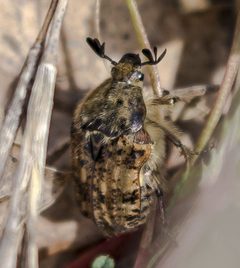
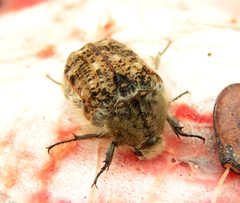
Euphoria inda is a scarab beetle in the Cetoniinae, commonly known as the bumble flower . are active that feed on pollen, nectar, sap, and damaged fruits. The is notable for its distinctive : adults do not lift their during flight, causing the hindwings to vibrate inside and produce a buzzing sound. It is widely distributed across North America and has been documented in large numbers at fermented traps in prairie and woodland .
Pronunciation
How to pronounce Euphoria inda: /juːˈfɔː.riə ˈɪn.də/
These audio files are automatically generated. While they are not always 100% accurate, they are a good starting point.
Identification
can be recognized by their robust, oval body form typical of flower chafers. The is distinguished from the similar Euphoria sepulchralis (dark flower scarab) by generally lighter coloration and different seasonal abundance patterns. The buzzing sound, produced by vibrating hindwings enclosed beneath the , is a distinctive behavioral cue.
Images
Habitat
Found in shortgrass prairie, oak-pine-juniper woodland, hackberry-bumelia-juniper canyon woodland, and mesquite chaparral. are attracted to sap flows on hardwood trees and frequently encountered at fermented traps.
Distribution
Nearctic: USA (Alabama, Arizona, Arkansas, California, Colorado, Connecticut, Delaware, Florida, Georgia, Idaho, Illinois, Indiana, Iowa, Kansas, Kentucky, Maine, Maryland, Massachusetts, Michigan, Minnesota, Mississippi, Missouri, Montana, Nebraska, Nevada, New Hampshire, New Jersey, New Mexico, New York, North Carolina, North Dakota, Ohio, Oklahoma, Oregon, Pennsylvania, Rhode Island, South Carolina, South Dakota, Tennessee, Texas, Utah, Vermont, Virginia, Washington, West Virginia, Wisconsin, Wyoming) and Canada (Alberta, British Columbia, Manitoba, Ontario, Quebec, Saskatchewan). Neotropical: Mexico (Chihuahua, Colima, Distrito Federal, Durango, Guanajuato, Hidalgo, Jalisco, México, Michoacán, Morelos, Nuevo León, Puebla, Sinaloa, Sonora, Veracruz).
Seasonality
have been documented from May through October, with peak abundance in late summer and early fall (August-October) in the south-central United States.
Diet
feed on pollen, nectar, sap flows, and damaged or fermenting fruits. They are attracted to fermenting sap, which may contain alcohol that affects their .
Behavior
do not lift their during ; the hindwings vibrate inside the closed elytra, producing a characteristic buzzing sound. Adults are frequently attracted to fermented traps (sweet red wine, ethanol, or blends) and are known to aggregate at sap flows on stressed hardwood trees.
Ecological Role
function as . Their attraction to fermented substrates and sap flows contributes to nutrient cycling and decomposition processes. They serve as abundant food sources for other organisms in trap .
Human Relevance
may be considered minor pests in fruit production due to feeding on damaged fruits. They are commonly encountered by entomologists in trapping studies and are a frequent component of fermented bait trap catches in prairie and woodland .
Similar Taxa
- Euphoria sepulchralisDark flower scarab; similar size and body form but generally darker coloration; both co-occur at fermented traps and sap flows, though E. sepulchralis often dominates trap catches in some regions while E. inda peaks later in the season
- Cotinis nitidaGreen June beetle; shares attraction to fermented baits and sap flows; larger, metallic green-bronze coloration readily distinguishes