
Labarrus pseudolividus
(Balthasar, 1941)
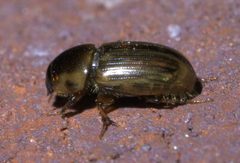
Labarrus pseudolividus is a dung beetle (Coleoptera: Scarabaeidae) native to the Nearctic and Neotropical regions, with introduced in Australia, New Zealand, and parts of Africa. The has been used as a model organism in methodology studies testing flotation and sieve-separation techniques for collecting dung beetles from pats. It is classified as a 'dweller' type dung beetle that inhabits dung rather than tunneling beneath it.


Pronunciation
How to pronounce Labarrus pseudolividus: /læˈbærəs ˌsjuːdoʊˈlɪvɪdəs/
These audio files are automatically generated. While they are not always 100% accurate, they are a good starting point.
Identification
Classified as a 'dweller' type dung beetle, distinguished from 'tunneler' such as Onthophagus taurus by its of inhabiting rather than constructing tunnels beneath it. Specific morphological diagnostic features are not described in available sources.
Images
Habitat
Cattle pastures; associated with fresh pats. Occupies natural dung substrates rather than being attracted to baited or light traps. The has been collected from field-colonized cattle dung in managed pasture systems.
Distribution
Native to Nearctic (USA: Arizona, California, Colorado, Florida, Hawaii, Iowa, Kansas, Louisiana, Maryland, Nevada, North Carolina, South Carolina) and Neotropical regions (Mexico, Central America, South America). Introduced to Australia, New Zealand, and parts of Africa (Angola, Botswana, Kenya, Mozambique, Namibia, South Africa, Tanzania, Zambia, Zimbabwe, Madagascar).
Diet
Animal ; specifically associated with fresh cattle dung in documented studies.
Behavior
Exhibits 'dweller' , inhabiting pats rather than tunneling beneath them. Can be collected via flotation methodology, where beetles move through submerged sieve and float to the water's surface. have been observed to survive flotation collection methods with high survival rates (>95%).
Ecological Role
Contributes to decomposition and nutrient cycling in pasture . As a dung beetle, participates in reducing pest, , and associated with livestock dung, and enhances soil through humification and reduction of point-source fecal pollution.
Human Relevance
Used as a test organism for developing dung beetle collection methodologies, particularly flotation and sieve-separation techniques. Has potential application in restoration, conservation programs, and laboratory colony formation. The high survival rate (>95%) under flotation collection makes it suitable for live collection and relocation efforts.
Similar Taxa
- Onthophagus taurusBoth are dung beetles used in the same methodology study, but O. taurus is a 'tunneler' type that constructs tunnels beneath , whereas L. pseudolividus is a 'dweller' type that inhabits the dung itself. This behavioral difference affects collection and sorting using flotation methods.
More Details
Collection Methodology
Flotation collection of L. pseudolividus from pats achieved 72.4% recovery rate with >95% survival. A flotation-sieving technique enables rapid collection and passive sorting by size within a series of sieves, allowing collection of 50–100 g of wild dung beetles within a few hours.