
Labarrus
Mulsant & Rey, 1869
Species Guides
2Labarrus is a of scarab beetles in the Scarabaeidae, Aphodiinae, comprising approximately 19 described . Members are dung beetles that employ a 'dweller' strategy, living and feeding within pats rather than tunneling beneath them. The genus has been introduced to multiple regions outside its native range, including Hawaii, Puerto Rico, and the continental United States, for purposes including restoration. Labarrus pseudolividus is the best-studied species, with documented recovery rates of 72.4% using flotation collection methods and survival rates exceeding 95%.
Pronunciation
How to pronounce Labarrus: //læˈbæ.rəs//
These audio files are automatically generated. While they are not always 100% accurate, they are a good starting point.
Identification
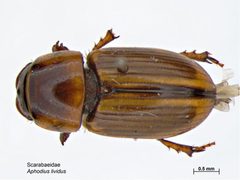
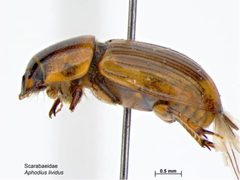
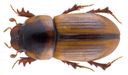
Distinguished from tunneling dung beetles by their dweller —remaining within pats rather than constructing burrows below. Labarrus may be separated from similar Aphodiinae by genitalic and external morphological characters, though specific diagnostic features require examination. The genus has been historically synonymized with Aphodius, and some sources still list Labarrus as a subgenus of Aphodius.
Images
Habitat
Cattle pastures and environments with fresh substrates. inhabit dung pats directly, living within the matrix rather than in underlying soil.
Distribution
Native to the Palaearctic, Oriental, Afrotropical, and Australian regions. Introduced to the Nearctic (continental United States, specifically documented in North Carolina), Hawaii, and Puerto Rico. GBIF records indicate presence across all major biogeographic regions.
Diet
Animal for consumption and . As dwellers, they feed directly within dung pats.
Life Cycle
Dweller life strategy: , larvae, and develop within pats rather than in burrows or soil below. This immobile association with substrate may reduce collection by flotation methods for some life stages.
Behavior
Lives within pats (dweller ); colonizes fresh cattle dung. When collected, individuals can be slowed into torpor at 10°C for handling and storage. In sieving apparatus, beetles self-sort by size when placed in stacked sieves.
Ecological Role
Dung beetle engineer contributing to nutrient cycling, pasture health, and reduction of pest and . Improves soil through incorporation and humification, enhances water infiltration, and reduces point-source fecal pollution. Serves as a bioindicator for localized dung beetle diversity.
Human Relevance
Used in restoration and conservation programs; introduced to new regions for services. Targeted for laboratory colony formation. Collection methodologies have been specifically developed and tested for this , with flotation-sieve techniques achieving high recovery and survival rates.
Similar Taxa
- AphodiusHistorical taxonomic confusion; Labarrus was formerly treated as a subgenus of Aphodius and some authorities still maintain this classification. Both are Aphodiinae dung beetles with similar , requiring genitalic examination for definitive separation.
- OnthophagusBoth are dung beetles in Scarabaeidae, but Onthophagus are tunnelers that burrow beneath pats, whereas Labarrus species are dwellers living within the dung itself. This ecological difference has practical implications for collection methodology.
More Details
Taxonomic Status
NCBI lists Labarrus as a subgenus of Aphodius, while Catalogue of Life and other sources treat it as a valid . This discrepancy reflects ongoing taxonomic debate within Aphodiinae.
Collection Methodology
Flotation methods achieve 72.4% recovery of L. pseudolividus with >95% survival, outperforming some traditional trap methods for this dweller . The technique is particularly effective because dwellers remain within pats that can be completely processed, unlike tunnelers that may escape below the collection zone.