
Dorcus brevis
(Say, 1825)
Eastern American Stag Beetle
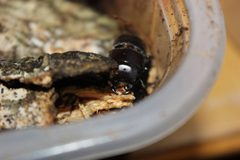
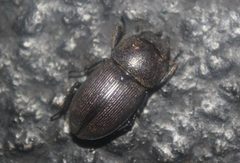
Dorcus brevis is a native to the eastern United States. It is a wood-associated species with larvae that develop in decaying hardwood. can be distinguished from the closely related Dorcus parallelus by body proportions and structure.
Pronunciation
How to pronounce Dorcus brevis: /ˈdɔrkʊs ˈbrɛvɪs/
These audio files are automatically generated. While they are not always 100% accurate, they are a good starting point.
Identification
Distinguished from Dorcus parallelus by broader body proportions, smooth , and relatively short . Female D. brevis have unidentate mandibles versus bidentate mandibles in female D. parallelus.
Images
Appearance
Body proportionally broader than related . smooth. Males have relatively short compared to other stag beetles. Females have unidentate mandibles.
Habitat
Associated with decomposing wood in hardwood forests.
Distribution
Eastern United States: Alabama, Florida, Georgia, Illinois, Indiana, Kansas, Maryland, Michigan, Mississippi, Missouri, New Jersey, North Carolina, Oklahoma, South Carolina, Tennessee, Virginia.
Diet
Larvae feed on decomposing wood, particularly white oak.
Host Associations
- Quercus alba - larval food sourcedecomposing wood
Life Cycle
Larvae are wood-borers that develop in decaying wood.
Ecological Role
Contributes to wood decomposition as larvae tunnel through decaying hardwood.
Similar Taxa
- Dorcus parallelusOverlapping range and general appearance; distinguished by narrower body, less smooth , longer in males, and bidentate mandibles in females.
More Details
Taxonomic history
First described by Thomas Say in 1825.