Phaenonotum exstriatum
(Say, 1835)
Phaenonotum exstriatum is a of water scavenger beetle in the Hydrophilidae. It has a broad distribution spanning North America, Central America, and the Caribbean, with records extending into South America. The species is characterized by its dark coloration, ranging from dark brown to black. As a member of the Sphaeridiinae, it belongs to a group commonly known as the lesser dung beetles, though many sphaeridiines occupy aquatic or moist rather than strictly -associated .
Pronunciation
How to pronounce Phaenonotum exstriatum: //ˌfiːnəˈnoʊtəm ɛkˌstraɪˈeɪtəm//
These audio files are automatically generated. While they are not always 100% accurate, they are a good starting point.
Identification
Identification to level requires examination of subtle morphological features, particularly male genitalia, as Phaenonotum species are morphologically similar. The species can be distinguished from by characteristics of the and potentially by the absence of (implied by the specific epithet 'exstriatum,' meaning 'without striae'), though this interpretation should be verified against original description. Regional distribution may assist in narrowing possibilities, as P. exstriatum has a broad New World range overlapping with several congeners.
Images
Appearance
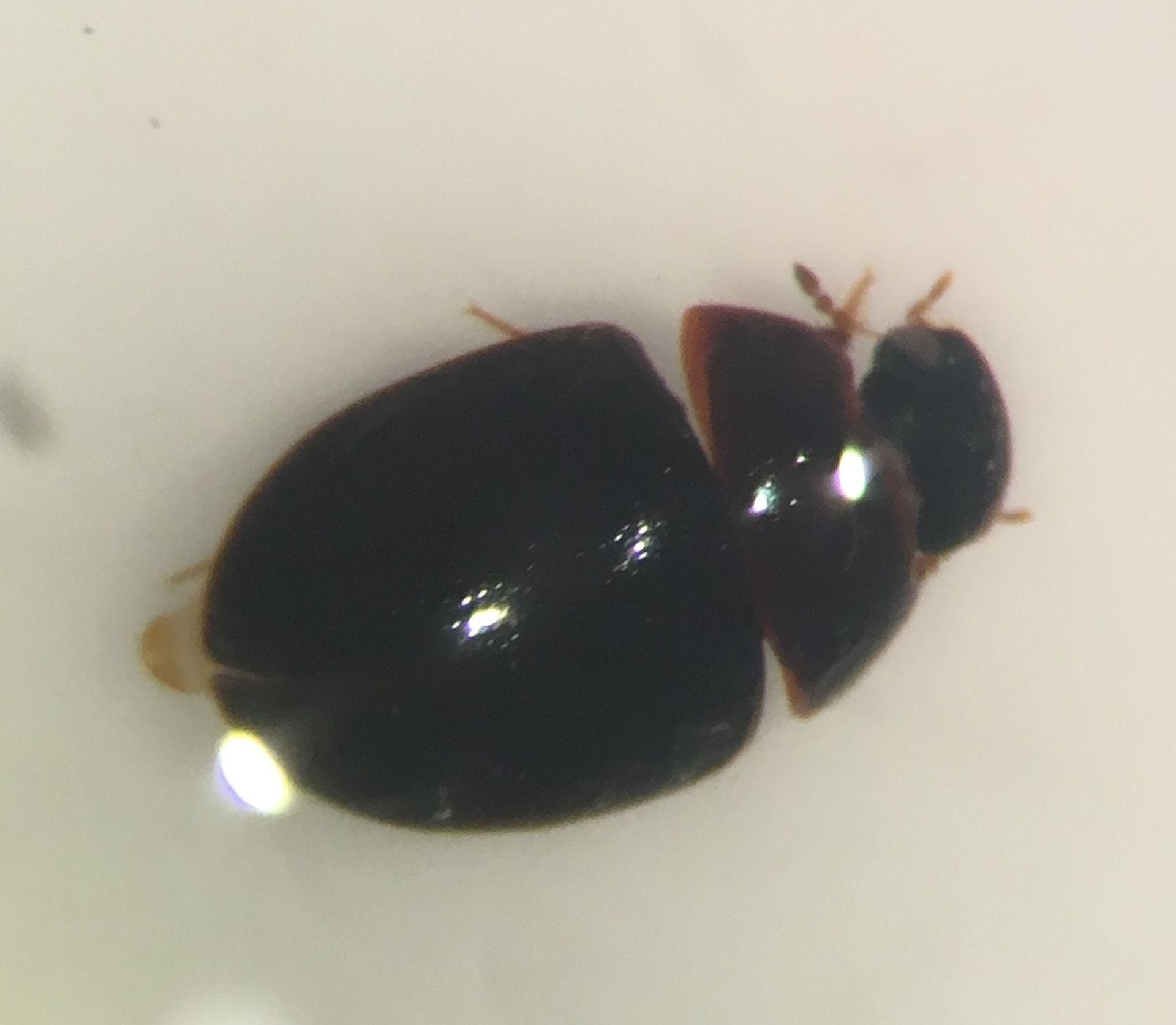
Dark brown to black in color. As with other members of Phaenonotum, the body is compact and convex. Specific morphological details such as size, punctation patterns, and male genitalia characteristics require examination of or specialized taxonomic literature.
Habitat
Aquatic or semi-aquatic environments typical of Hydrophilidae. Specific microhabitat preferences are not well documented, but related in Sphaeridiinae often occur in decaying organic matter, wet detritus, or margins of water bodies.
Distribution
Widely distributed in the New World. North American records include the southeastern and south-central United States (Alabama, Arizona, Arkansas, Florida, Georgia, Illinois, Indiana, Kansas, Louisiana, Maryland, Michigan, Mississippi, Missouri, New Jersey, New York, Ohio, Oklahoma, Pennsylvania, South Carolina, Tennessee, Texas, Virginia), plus Washington D.C. and Delaware. Central American records: Mexico, Guatemala, Rica, Panama. Caribbean records: Cuba, Jamaica, Haiti, Dominican Republic, Puerto Rico, Dominica, Grenada, Guadeloupe, Montserrat, Grand Cayman, Trinidad. South American records: Colombia, Brazil, Argentina.
Ecological Role
As a water scavenger beetle, likely contributes to decomposition of organic matter in aquatic or moist . Specific ecological functions have not been studied.
Similar Taxa
- Phaenonotum species within Phaenonotum are morphologically similar and require dissection and examination of male genitalia for reliable identification. The contains multiple with overlapping distributions in the Neotropics and Nearctic regions.
- Other SphaeridiinaeMembers of this share compact, convex body forms and similar preferences. Differentiation requires attention to tribal and generic characteristics such as antennal club structure and prosternal features.
More Details
Taxonomic note
The specific epithet 'exstriatum' suggests a lack of (grooves or lines), which may refer to elytral absent in this but present in related . This interpretation is based on etymology and should be confirmed against the original description by Thomas Say (1835).
Observation rarity
Despite a broad geographic range, the has relatively few documented observations on iNaturalist (15 records as of source date), suggesting it may be underreported, cryptic in habits, or genuinely uncommon in many parts of its range.