
Cymbiodyta
Bedel, 1881
Species Guides
8- Cymbiodyta acuminata(water scavenger beetle)
- Cymbiodyta bifida
- Cymbiodyta dorsalis
- Cymbiodyta fraterculus
- Cymbiodyta minima(water scavenger beetle)
- Cymbiodyta pacifica
- Cymbiodyta rotunda
- Cymbiodyta vindicata
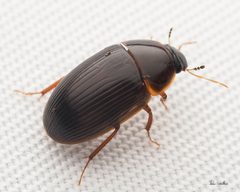
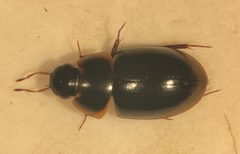
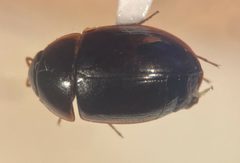
Cymbiodyta is a of water scavenger beetles (Hydrophilidae: Enochrinae) comprising 31 described . The genus exhibits a strikingly disjunct distribution: 28 species occur in the Americas, while only three species inhabit the Palearctic region. A fossil species from Eocene Baltic amber (C. samueli) confirms the genus has persisted in Europe since at least the Eocene, supporting biogeographic reconstructions indicating an ancient Euro-American distribution dating to the Late Cretaceous when land connections existed between North America and Europe.
Pronunciation
How to pronounce Cymbiodyta: /sɪmbiˈɒdɪtə/
These audio files are automatically generated. While they are not always 100% accurate, they are a good starting point.
Images
Distribution
Americas (28 ) and Palearctic (3 species: C. marginella, C. lishizheni, C. orientalis). GBIF records document occurrence in Denmark, Norway, and Sweden. The fossil C. samueli from Eocene Baltic amber (Lithuania) confirms European presence since at least 34 million years ago. Biogeographic analysis indicates the ancestral range encompassed both Europe and North America, with European lineages representing ancient relicts that have declined to a single surviving species (C. marginella).
Sources and further reading
- BugGuide
- Wikipedia
- GBIF taxonomy match
- iNaturalist taxon
- NCBI Taxonomy
- Catalogue of Life
- REVISION OF THE GENUS CYMBIODYTA BED. (COLEOPTERA: HYDROPHILIDAE)
- Fossil Cymbiodyta from Baltic amber confirms Euro-American ancient distribution of the genus (Coleoptera: Hydrophilidae)
- Figure 4 from: Fikáček M, Pražák JS, Short AEZ, Rion F (2023) Fossil Cymbiodyta from Baltic amber confirms Euro-American ancient distribution of the genus (Coleoptera: Hydrophilidae). Arthropod Systematics & Phylogeny 81: 555-563. https://doi.org/10.3897/asp.81.e100385
- Figure 2 from: Fikáček M, Pražák JS, Short AEZ, Rion F (2023) Fossil Cymbiodyta from Baltic amber confirms Euro-American ancient distribution of the genus (Coleoptera: Hydrophilidae). Arthropod Systematics & Phylogeny 81: 555-563. https://doi.org/10.3897/asp.81.e100385
- Figure 1 from: Fikáček M, Pražák JS, Short AEZ, Rion F (2023) Fossil Cymbiodyta from Baltic amber confirms Euro-American ancient distribution of the genus (Coleoptera: Hydrophilidae). Arthropod Systematics & Phylogeny 81: 555-563. https://doi.org/10.3897/asp.81.e100385
- Figure 3 from: Fikáček M, Pražák JS, Short AEZ, Rion F (2023) Fossil Cymbiodyta from Baltic amber confirms Euro-American ancient distribution of the genus (Coleoptera: Hydrophilidae). Arthropod Systematics & Phylogeny 81: 555-563. https://doi.org/10.3897/asp.81.e100385