
Euspilotini
Genus Guides
2- Euspilotus(clown beetles)
- Geomysaprinus(clown beetles)
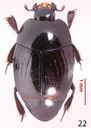
Euspilotini is a tribe of clown beetles (Histeridae) within the Histerinae. Members are small to medium-sized beetles associated with decomposing organic matter. The tribe is distinguished by specific modifications of the and mesosternum. Euspilotini has a primarily New World distribution, with greatest diversity in the Neotropics.
Pronunciation
How to pronounce Euspilotini: //juːˈspɪlətɪnaɪ//
These audio files are automatically generated. While they are not always 100% accurate, they are a good starting point.
Identification
Euspilotini can be distinguished from related tribes in Histerinae by the structure of the prosternal lobe and mesosternal cavity. The typically has a distinct lobe that fits into a corresponding cavity on the mesosternum. These modifications create a characteristic locking mechanism between the pro- and . within the tribe vary in body form from elongate to more compact, oval shapes. Antennal clubs are usually distinctly three-segmented. The presence of strial patterns on the varies among .
Images
Habitat
of Euspilotini are found in containing decomposing organic matter. This includes carrion, , decaying fungi, and compost. Some species are associated with subcortical habitats under bark of dead or dying trees. Others have been recorded from leaf litter and rotting vegetation.
Distribution
The tribe has a primarily New World distribution. It occurs from southern Canada through the United States, Mexico, Central America, and throughout South America. The greatest occurs in the Neotropical region. Some extend into the Nearctic, with fewer representatives at higher latitudes.
Diet
Larvae and are predatory, feeding on the and larvae of flies and other insects found in decomposing substrates. Specific prey records are limited for most .
Life Cycle
Development occurs within decomposing organic substrates. Larvae are active . takes place in the substrate or in adjacent soil. Multiple per year are likely in tropical regions, with reduced seasonality in temperate areas.
Behavior
are attracted to decomposing matter and are frequently collected at carrion or baits. They are rapid runners and readily take when disturbed. Some exhibit marginal burrowing in soft substrates.
Ecological Role
As of fly and larvae, Euspilotini contribute to the regulation of dipteran in decomposing matter. They form part of the successional fauna on carrion and are used in in some regions.
Human Relevance
Certain are utilized in to estimate postmortem intervals based on their predictable of human remains. The tribe has potential value in of pest flies associated with livestock operations, though this application remains underdeveloped.
Similar Taxa
- HisteriniAlso in Histerinae, but distinguished by different prosternal-mesosternal interlocking mechanisms and generally more robust body form.
- PlatysomatiniOverlaps in use but has distinct body shape and antennal structure; members are often more strongly flattened.
More Details
Taxonomic History
The tribal classification of Histerinae has undergone revision, with Euspilotini recognized based on characters of the thoracic sterna. Generic limits within the tribe remain under study.
Collection Methods
Pitfall traps baited with carrion or are effective for sampling. Subcortical are collected by peeling bark from recently dead hardwoods.