
Hister
Linnaeus, 1758
Clown Beetles
Species Guides
17- Hister abbreviatus(clown beetle)
- Hister civilis(clown beetle)
- Hister coenosus(clown beetle)
- Hister comes(clown beetle)
- Hister curtatus(clown beetle)
- Hister defectus(clown beetle)
- Hister depurator(clown beetle)
- Hister dispar(clown beetle)
- Hister furtivus(clown beetle)
Hister is a of clown beetles in the Histeridae, comprising small to medium-sized predatory beetles with distinctive compact, oval bodies and clubbed . Members of this genus are typically shiny black or metallic in coloration and are found in diverse worldwide. The genus is taxonomically significant as the type genus of the family Histeridae, with identification relying heavily on elytral patterns and male genitalia characteristics. Some species exhibit morphological variability in elytral striae configuration, which has been documented in detail for H. shanghaicus.


Pronunciation
How to pronounce Hister: /ˈhɪstər/
These audio files are automatically generated. While they are not always 100% accurate, they are a good starting point.
Identification
Identification of Hister relies primarily on the configuration of elytral , which serve as key diagnostic characters. Typical specimens possess dorsal elytral striae I–II complete with basally abbreviated stria III and normally absent sutural elytral stria, though extremes range from fully developed stria III with nearly complete sutural stria to obsolete stria III with reduced or absent sutural stria. Male genitalia remain stable and reliable for species identification despite variability in external striae patterns. The is characterized by compact, oval body form, clubbed with three-segmented clubs, and typically shiny black or metallic coloration.
Images
Distribution
The Hister has a broad distribution including North America, Europe, Asia, and other regions. Specific documented occurrences include southern and south-eastern China (Shanghai, Zhejiang, Fujian, Guangdong, Jiangxi Provinces), Laos, Vietnam, Mongolia, and the territory of the former USSR. Records from North America include observations from northwestern Oklahoma. Distribution records in GBIF indicate presence in Norway and Sweden.
Similar Taxa
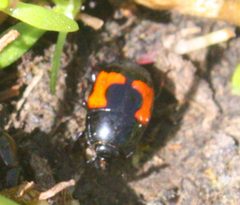
- SpilodiscusBoth are histerid with similar compact body forms, but Spilodiscus is distinguished by color patterns such as red and black maculations on the , whereas Hister are typically uniformly black or metallic without such contrasting markings.
- UlkeusBoth belong to Histeridae, but Ulkeus is placed in Hetaeriinae and is myrmecophilous, associated with legionary ants in the Neivamyrmex, whereas Hister is in subfamily Histerinae and is not known to have such specialized associations.
- PlatysomaBoth are predatory histerid , but Platysoma exhibit more elongated body forms and have been specifically documented to utilize bark beetle as kairomonal odor cues for finding, with differential attraction to horizontal versus vertical logs facilitating partitioning— not explicitly documented for Hister.
- MargarinotusBoth are histerine with similar general , but Margarinotus can be distinguished by specific genitalic and external structural characters detailed in taxonomic keys; the two genera overlap in distribution in China and other regions.
More Details
Etymology
The name Hister (genitive Histri) derives from the Latin name for the Danube River, especially its lower course, or for the people living along its banks.
Taxonomic Significance
Hister is the type of the Histeridae, making it central to the family's nomenclatural stability. The family name itself derives from this genus.
Morphological Variability
Studies of Hister shanghaicus have documented significant intraspecific variation in elytral configuration, with specimens from Gutian Nature Reserve (Guangdong Province) and Jiulianshan Nature Reserve (Jiangxi Province) showing a continuous range from nearly complete strial development to strongly reduced patterns. This variability underscores the importance of using male genitalia rather than external striae patterns alone for definitive identification.
Sources and further reading
- BugGuide
- GBIF taxonomy match
- iNaturalist taxon
- NCBI Taxonomy
- Catalogue of Life
- Bohart Museum Features UC Davis Forensic Entomologist Bob Kimsey | Bug Squad
- Histeridae | Beetles In The Bush
- Two new Clown beetle genera and 4 new species | Blog
- Bug Eric: A Couple of Weirdos
- The description of new species Hister (Coleoptera: Histeridae) from Mongolia and the new data on distribution of hister beetles in territory of the former USSR
- Morphological variability of Hister shanghaicus Marseul, 1862 (Coleoptera, Histeridae)
- Biology and host finding of predaceous hister beetles (Coleoptera: Histeridae) associated with Ips spp. (Coleoptera: Scolytidae) in loblolly pine (Pinus taeda L.)
- A Hister Beetle Carcinops pumilio (Erichson) (Insecta: Coleoptera: Histeridae: Dendrophilinae: Paromalini)
- Two new Margarinotus Marseul, 1853 from Jiangxi, Guangxi, and Guangdong provinces (China), with an updated key to all Chinese species (Coleoptera, Histeridae, Histerinae, Histerini).