
Georissidae
Laporte de Castelnau, 1840
minute mud-loving beetles
Genus Guides
1- Georissus(minute mud-loving beetles)
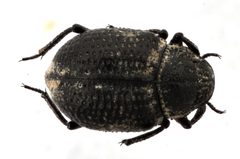
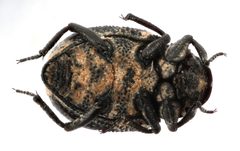
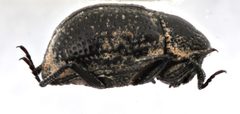
Georissidae is a small of beetles commonly known as minute mud-loving beetles, containing the single Georissus. Members are tiny insects typically found in wet soil and riparian environments near water. Some have been documented in atypical such as cloud forest leaf litter. The family exhibits notable morphological and behavioral diversity, including psammophory (sand adherence for camouflage) in some subgenera and aptery (winglessness) in certain species.
Pronunciation
How to pronounce Georissidae: //dʒiːoʊˈrɪsɪdiː//
These audio files are automatically generated. While they are not always 100% accurate, they are a good starting point.
Identification
Georissidae can be distinguished from other small soil-dwelling beetles by their placement in Hydrophiloidea. Subgenera may be differentiated by behavioral traits: subgenus Georissus (s.str.) exhibits psammophory (sand adherence for camouflage), while subgenus Neogeorissus does not. -level identification requires examination of and other genitalic structures.
Images
Habitat
Typically found in wet soil and riparian zones near water. Some occur in cloud forest leaf litter and other terrestrial . Documented from Western Tien-Shan mountains in Kyrgyzstan and Mt. Kinabalu National Park in Borneo.
Distribution
Found on every continent except Antarctica. Documented from Spain, Portugal, Kyrgyzstan (Western Tien-Shan), and Borneo (Sabah, Malaysia). The includes 139 recorded from the El Bierzo region of northwestern Spain, with 23 new records documented in 2015.
Life Cycle
cocoons and pupae have been described for Georissus crenulatus based on laboratory rearing. First instar larvae lack cephalic egg bursters, a trait that appears generally absent in Hydrophiloidea.
Behavior
Psammophory (camouflage via adherence of sand particles to the body) is characteristic of subgenus Georissus (s.str.) but not subgenus Neogeorissus. Some are wingless (). Multiple species may co-occur in the same locality.
Similar Taxa
- HelophoridaeBoth are small of Hydrophiloidea associated with aquatic or semi-aquatic ; distinguished by and habitat preferences.
- HydrochidaeAnother small of Hydrophiloidea with aquatic/semi-aquatic members; Georissidae distinguished by soil-dwelling habits and psammophory in some subgenera.
More Details
Taxonomic Note
Georissidae contains only the Georissus, which is divided into subgenera including Georissus (s.str.) and Neogeorissus.
Conservation Interest
In the El Bierzo region of Spain, Georissidae contributes to high of aquatic beetles, with 20% of being Iberian endemics mostly associated with mountain streams.
Sources and further reading
- BugGuide
- iNaturalist taxon
- NCBI Taxonomy
- Catalogue of Life
- Contribution to the fauna and biology of Georissidae (Coleoptera) of Kyrgyzstan
- A new species of leaf-litter inhabiting Georissus from Borneo (Coleoptera: Hydrophiloidea: Georissidae)
- Georissus substriatus Heer, 1841 (Coleoptera: Georissidae) in the Iberian Peninsula; rectification the records from Portugal
- Observations on the immature stages of Georissidae (Coleoptera : Hydrophiloidea), with remarks on the evolution of the hydrophiloid egg cocoon
- An annotated checklist of the aquatic Polyphaga (Coleoptera) of Egypt III. Families: Helophoridae, Georissidae, Hydrochidae, Spercheidae, Scirtidae, Elmidae, Dryopidae, Limnichidae and Heteroceridae
- Los coleópteros acuáticos y semiacuáticos de la comarca de El Bierzo (León, NO de España) (Coleoptera: Gyrinidae, Haliplidae, Noteridae, Hygrobiidae, Dytiscidae, Helophoridae, Georissidae, Hydrochidae, Hydrophilidae, Hydraenidae, Scirtidae, Dryopidae, Elmidae, Heteroceridae) - Reunión del Balfour~Browne Club, 25-30 junio 2015