
Georissus
Latreille, 1809
minute mud-loving beetles
Species Guides
2Georissus is the sole in the Georissidae, comprising approximately 75 described of minute beetles. Members are distinguished by their habit of psammophory—actively covering their with sand or mud particles as a defensive . The genus exhibits notable ecological flexibility, with most species inhabiting riparian mud and sand, while some occupy tropical rainforest leaf litter and cloud forest terrestrial . The genus is divided into three subgenera: Georissus, Neogeorissus, and Nipponogeorissus.
Pronunciation
How to pronounce Georissus: //dʒiːəˈrɪsəs//
These audio files are automatically generated. While they are not always 100% accurate, they are a good starting point.
Identification
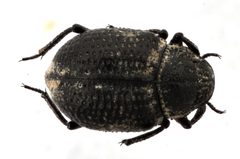
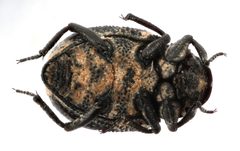
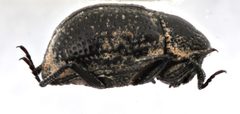
Georissus can be distinguished from other small, oval beetles in wet by the combination of: minute size (1–2 mm), granulate sculpturing on and pronotum, interrupted body outline at the pronotum- junction, and the absence of intercoxal processes on the . The habit of psammophory—elytra covered with adhering substrate particles—is a strong behavioral indicator. The Georissidae was formerly included in Hydrophilidae but is now recognized as distinct based on molecular data; Georissus differs from hydrophilid in its and and prosternum.
Images
Habitat
Primarily found in wet soil and saturated substrates, particularly at the periphery of rivers and streams. Some occupy tropical rainforest leaf litter, including cloud forest at elevation. The shows ecological partitioning between riparian and terrestrial microhabitats.
Distribution
distribution spanning every continent except Antarctica. Documented from: Europe (including Iberian Peninsula, Scandinavia), Asia (Japan, Taiwan, Malaysia/Borneo, Sri Lanka), Africa (Republic of the Congo), North America, South America (Colombia), and Australia.
Diet
Predatory on . has been observed under laboratory conditions.
Behavior
Psammophory: active covering of with sand or mud particles, which functions as protection against . Some exhibit aptery (winglessness).
Ecological Role
in of wet soil and leaf litter microhabitats.
Similar Taxa
- Hydrophilidae (water scavenger beetles)Formerly classified within this ; distinguished by and , , and psammophory
- HelophoridaeRelated within Hydrophiloidea clade; Georissus differs in preference and morphological details of and coxal structure
- HydrochidaeRelated within Hydrophiloidea; Georissus is smaller and exhibits substrate-covering not typical of hydrochids
More Details
Systematic position
Molecular data place Georissidae in a clade with Epimetopidae, Hydrochidae, and Helophoridae within Hydrophiloidea, distinct from Hydrophilidae where it was formerly classified.
Subgeneric classification
The is divided into three subgenera: Georissus, Neogeorissus, and Nipponogeorissus.
Habitat divergence
While most Georissus are riparian, at least three species (G. smetanai, G. lateralis, G. inflatus) have independently colonized leaf-litter , suggesting ecological plasticity within the .
Sources and further reading
- BugGuide
- Wikipedia
- GBIF taxonomy match
- iNaturalist taxon
- NCBI Taxonomy
- Catalogue of Life
- A new species of leaf-litter inhabiting Georissus from Borneo (Coleoptera: Hydrophiloidea: Georissidae)
- Georissus substriatus Heer, 1841 (Coleoptera: Georissidae) in the Iberian Peninsula; rectification the records from Portugal