
Caenia dimidiata
(Fabricius, 1801)
Terminal Net-winged Beetle
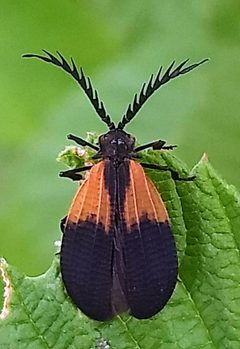
Caenia dimidiata is a of net-winged beetle in the Lycidae, known as the Terminal Net-winged Beetle. It is found in North America, with records from Canada and the United States. The species exhibits the characteristic black-and-orange or red warning coloration typical of lycid beetles, which serves as aposematic signaling. It participates in Müllerian mimicry complexes with other toxic insects, including in the Pyromorpha.
Pronunciation
How to pronounce Caenia dimidiata: /ˈsiːniə dɪˌmɪdiˈɑːtə/
These audio files are automatically generated. While they are not always 100% accurate, they are a good starting point.
Identification
Caenia dimidiata can be distinguished from similar net-winged beetles by the terminal band pattern on the . It resembles the unrelated Pyromorpha dimidiata (orange-patched smoky moth), which shares similar black-and-orange coloration; however, C. dimidiata can be separated by its including hardened forewings (elytra) and clubbed . The Calopteron terminale (end band net-wing) is another similar lycid beetle that participates in the same mimicry complex.
Images
Habitat
Found in forested areas, particularly those with oak presence. Observations include mature white oak (Quercus alba) forest .
Distribution
North America. Specific records include: Manitoba, New Brunswick, and Nova Scotia in Canada; additional records throughout the United States.
Behavior
are and active during daylight hours. The participates in Müllerian mimicry complexes, where both the and its mimics (such as Pyromorpha dimidiata ) are toxic and share warning coloration.
Ecological Role
Serves as a model in Müllerian mimicry rings, providing the warning coloration pattern that other toxic insects (including in Zygaenidae and ) have evolved to resemble. The family Lycidae acts as a 'leader' in these mimicry associations due to its and consistent aposematic signals.
Human Relevance
Subject of ecological and entomological study due to its role in mimicry complexes. The is photographed and documented by naturalists; observations are well-represented on citizen science platforms.
Similar Taxa
- Pyromorpha dimidiataUnrelated in Zygaenidae that exhibits convergent black-and-orange warning coloration; distinguished by moth (scaled wings, different ) and
- Lycomorpha pholusBlack-and-yellow lichen moth ( Erebidae: Arctiinae) that also participates in the lycid mimicry complex; distinguished by yellow rather than orange coloration and later in late summer
- Calopteron terminaleCongeneric or closely related lycid with similar end band pattern and shared participation in the same Müllerian mimicry complex
More Details
Toxicity and chemical defense
Like other lycid beetles, C. dimidiata is toxic and serves as an authentic model in Müllerian mimicry rings. The related Pyromorpha dimidiata is also genuinely toxic, containing hydrogen cyanide in all life stages, making this a true Müllerian rather than association.
Taxonomic note
The specific epithet 'dimidiata' is shared with the Pyromorpha dimidiata, reflecting the parallel naming of these mimicry partners. The was described by Fabricius in 1801.