
Hypnoidus nocturnus
(Eschscholtz, 1829)
Nocturnal Click Beetle
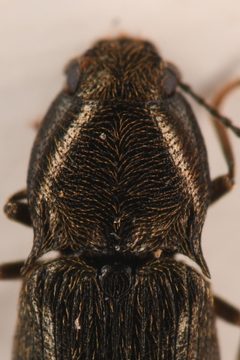
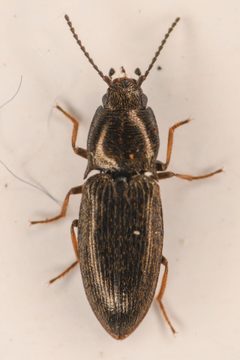
Hypnoidus nocturnus is a of click beetle (Elateridae) commonly known as the Click Beetle. It is distributed across northern and western North America, including Alaska, western Canada, and associated regions. The species is characterized by its small size, dark coloration, and the ability to produce a clicking sound by flexing its body—a defensive mechanism shared with other members of the . Observations of this species remain limited, with few documented records in public databases.
Pronunciation
How to pronounce Hypnoidus nocturnus: //hɪpˈnɔɪdəs nɒkˈtɜːrnəs//
These audio files are automatically generated. While they are not always 100% accurate, they are a good starting point.
Identification
Distinguished from other Hypnoidus by its small size, uniformly dark coloration, and geographic distribution in northern and western North America. The species lacks the distinct pale markings or reddish tones found in some . Males may be separated from females by differences in antennal structure, though this requires close examination. Similar to Hypnoidus bicolor but darker and with a more northern distribution. Identification to species level often requires examination of genitalia or association with geographic location.
Images
Appearance
Small to medium-sized click beetle with dark, often black or brown coloration. Body form is elongated and somewhat flattened, typical of the Hypnoidus. are serrate (saw-like) and moderately long. The pronotum is slightly wider than long, with angles that may bear small teeth or projections. are striated with fine punctures. Overall body length approximately 5–8 mm.
Habitat
Found in forested and wooded , particularly in coniferous and mixed woodlands. Associated with decaying wood, leaf litter, and soil environments where larvae develop. Occurs in montane and forest zones.
Distribution
Northern and western North America: Alaska (USA), Yukon, British Columbia, and Alberta (Canada). Records indicate a and subarctic distribution pattern.
Seasonality
have been observed from late spring through summer, with peak activity likely occurring during warmer months. Specific data are limited due to low observation frequency.
Behavior
Possesses the characteristic clicking mechanism of Elateridae, where the can flex its body to produce a sharp click and launch itself into the air to escape . This is mediated by a prosternal process that engages with a mesosternal groove.
Ecological Role
Larvae likely function as decomposers in forest soil and decaying wood, contributing to nutrient cycling. may serve as prey for insectivorous birds and other .
Human Relevance
Minimal direct economic or agricultural significance. Not known to be a pest . Of interest to entomologists studying and subarctic faunas.
Similar Taxa
- Hypnoidus bicolorOverlaps in distribution but differs in having distinct bicolored with reddish or yellowish tones; H. nocturnus is uniformly dark.
- Other small ElateridaeMany small click beetles share general body form; H. nocturnus is distinguished by the combination of small size, dark color, serrate , and northern distribution.
More Details
Taxonomic History
Originally described by Eschscholtz in 1829. The has undergone limited taxonomic revision, and its placement in Hypnoidus reflects current understanding of elaterid .
Data Deficiency
This is poorly represented in biological collections and observation databases, with only seven observations recorded in iNaturalist as of the source date. This scarcity likely reflects its northern distribution and habits rather than true rarity.