
Athous haemorrhoidalis
(Fabricius, 1801)
common brown click beetle
Athous haemorrhoidalis is a click beetle native to Europe and Asia, characterized by its slender body and ability to launch itself into the air when disturbed. The species exhibits , with males smaller than females and showing less pronounced pronotal margins. are active primarily in summer months, particularly July, and serve as of certain orchid species. The larval stage, known as wireworms, develops in soil over 3-4 years and is recognized as an agricultural pest due to root-feeding damage.


Pronunciation
How to pronounce Athous haemorrhoidalis: /ˈæ.θaʊs ˌhiː.məˌrɔɪˈdeɪ.lɪs/
These audio files are automatically generated. While they are not always 100% accurate, they are a good starting point.
Identification
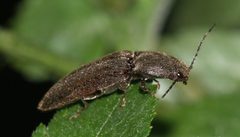
measure 10–15 mm in length with a slender build. The and are black, while the are brown with strong ribbing. are straight and extend to the back of the pronotum. The pronotum is distinctly dimpled across its surface and covered with greyish-brown hairs. Legs are paler brown than the elytra. is evident: males are smaller than females, and the lateral margin of the male pronotum is less wavy than the female's. The body is covered with greyish-brown throughout.
Images
Habitat
Found primarily in forests, including broad-leaved (oak and beech) and coniferous (Scots pine) types. Also occurs in wetland such as fens and peatlands. Predominantly a lowland , entirely absent above 600 m elevation, with decreasing abundance from sea level to 500 m. In agricultural settings, larvae inhabit soil of cereal fields, orchards, and potato crops.
Distribution
Widespread across Europe and Asia. Throughout the British Isles. Records include Belgium and São Miguel (Azores). Not established in North America; previous reports from British Columbia were based on misidentified specimens.
Seasonality
are most active in July in Europe, contrasting with many other click beetle that peak in spring. Adults emerge from soil in August, with peak in late August. Larval development spans multiple years in soil.
Diet
feed on pollen of flowers, including those of Pinus sylvestris (Scots pine), Rumex (dock), and Plantago (plantain). Larvae feed on roots of plants, primarily grasses in the Poaceae, and have been observed preying on winter moth (Operophtera brumata) larvae.
Life Cycle
Larval stage lasts 3-4 years, with larvae inhabiting soil and feeding on roots. occurs from late July to early August. emerge from soil in August, with peak in late August. are laid in autumn in soil among roots of plants. Adults are relatively short-lived compared to the extended larval development period.
Behavior
When disturbed, can flick themselves up to 245 mm into the air at takeoff speeds reaching 2.27 m/s, producing a loud clicking noise. This mechanism also allows self-righting if the lands on its back. Adults climb vegetation to access foliage and flowers. Larvae move vertically within the soil profile in response to temperature and moisture conditions.
Ecological Role
serve as , specifically documented as pollinators of the frog orchid (Coeloglossum viride). Larvae function as agricultural pests through root-feeding damage. The is an important prey item for birds, particularly tits and the collared flycatcher (Ficedula albicollis).
Human Relevance
Larvae are recognized as damaging agricultural pests, causing damage to cereal crops, orchards, and potato . The has been studied in agricultural entomology contexts for its and pest management implications. No other significant human interactions documented.
Similar Taxa
- Athous vittatusSimilar with both most active in July, though A. vittatus may be distinguished by different elytral patterning and pronotal .
- Other click beetle species (Elateridae)Many elaterid share the clicking/jumping mechanism; A. haemorrhoidalis is distinguished by its specific size range, coloration pattern (black / with brown ), and pronotal dimpling.
Sources and further reading
- BugGuide
- Wikipedia
- GBIF taxonomy match
- iNaturalist taxon
- NCBI Taxonomy
- The invasion that wasn’t | Beetles In The Bush
- The “black bringer of light” | Beetles In The Bush
- Gardening for Solitary Bees - Buglife Blog - Buglife
- ON THE LIFE HISTORY OF “WIRE WORMS” OF THE GENUS AGRIOTES, ESCH., WITH SOME NOTES ON THAT OF ATHOUS HAEMORRHOIDALIS, F.1
- ON THE LIFE HISTORY OF “WIREWORMS” OF THE GENUS AGRIOTES, ESCH., WITH SOME NOTES ON THAT OF ATHOUS HAEMORRHOIDALIS, F.1
- ON THE LIFE HISTORY OF “WIRE WORMS” OF THE GENUS AGRIOTES, ESCH., WITH SOME NOTES ON THAT OF ATHOUS HAEMORRHOIDALIS, F.: PART I