
Aeolus asper
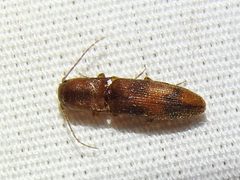
Aeolus asper is a of click beetle in the Elateridae. The Aeolus contains numerous small, often dull-colored species that are frequently associated with grasses and other herbaceous plants. This species is part of a large and taxonomically challenging group within the Elateridae. Available records suggest it is rarely encountered and poorly documented in the scientific literature.

Pronunciation
How to pronounce Aeolus asper: /ˈɛoʊləs ˈæspər/
These audio files are automatically generated. While they are not always 100% accurate, they are a good starting point.
Identification
Difficult to distinguish from other Aeolus without examination of male genitalia or other subtle morphological characters. The Aeolus is characterized by small size, dull coloration, and association with grassy . Within Elateridae, Aeolus species are separated from similar genera such as Agriotes or Dalopius by combinations of pronotal shape, antennal structure, and tarsal formula. Species-level identification in Aeolus generally requires knowledge and microscopic examination.
Images
Appearance
Small click beetle, likely under 10 mm in length. Members of the Aeolus typically have an elongated, somewhat parallel-sided body form with a dull, often brown or blackish coloration. The pronotum is usually slightly wider than long, with angles that may be slightly produced. are serrate or pectinate. Specific diagnostic features for A. asper are not well documented in available sources.
Habitat
Associated with herbaceous vegetation, particularly grasses. The Aeolus is ecologically linked to grassland, prairie, and meadow where larvae develop in soil or among plant roots.
Distribution
North America. Specific range details for A. asper are sparse; the Aeolus is broadly distributed across the continent with many showing regional or restricted ranges.
Behavior
possess the clicking mechanism characteristic of Elateridae, allowing them to right themselves when flipped onto their backs. This is achieved by a prosternal process engaging with a mesosternal groove.
Ecological Role
Larvae of Elateridae (wireworms) are generally soil-dwelling and feed on plant material; their specific ecological role in A. asper is undocumented but likely involves decomposition or herbivory in grassland soils.
Human Relevance
No documented economic importance. Not known as an agricultural pest. The rarity of records suggests minimal interaction with human activities.
Similar Taxa
- Aeolus mellillusSimilar small size, dull coloration, and grassy association; distinguished by subtle differences in pronotal and male genitalia.
- Agriotes speciesSimilar elongate body form and size; Agriotes typically has a more convex pronotum and different antennal structure.
More Details
Taxonomic Note
The Aeolus is taxonomically difficult with many described from limited material. A. asper is one of numerous species in this genus that lack comprehensive modern revision. The specific epithet 'asper' (Latin for 'rough') likely refers to surface sculpturing, though this is not confirmed in available sources.