
Oophorini
Gistel, 1848
Genus Guides
4- Aeolus(click beetles)
- Deronocus
- Heteroderes
- Monocrepidius
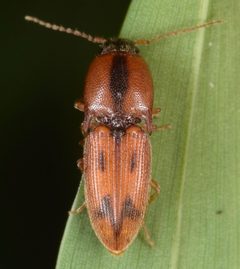
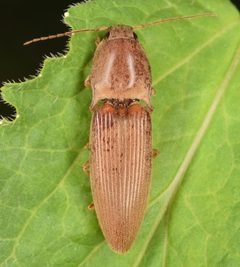
Oophorini is a tribe of click beetles within the Agrypninae, established by Gistel in 1848. The tribe contains approximately 20 including Monocrepidius (formerly Conoderus), one of the largest genera in Elateridae with roughly 380 worldwide. Most occurs in the Australian and Neotropical regions. The tribe includes the economically relevant genus Monocrepidius, whose larvae are known as wireworms.

Pronunciation
How to pronounce Oophorini: //oʊ.əˈfɔːrəˌnaɪ//
These audio files are automatically generated. While they are not always 100% accurate, they are a good starting point.
Identification
of Oophorini can be recognized as members of Agrypninae by the combination of characters typical for that . Larvae of at least some (e.g., Monocrepidius) possess diagnostic features including a penicillus (brush-like structure) on the and an abdominal IX with a lateral row of 6–7 setae, differing from related groups where the penicillus is absent and the lateral row bears only 2–3 setae.
Images
Distribution
Worldwide, with majority of diversity concentrated in Australian and Neotropical regions. The Monocrepidius is predominantly distributed in South America, especially Brazil.
Life Cycle
Mature larvae and pupae have been described for some (e.g., Monocrepidius fuscofasciatus). Larval stage exhibits morphological characters useful for taxonomic differentiation within the .
Human Relevance
Larvae of Monocrepidius (wireworms) are agricultural pests that feed on roots and underground plant parts, causing damage to crops.
Similar Taxa
- Other Agrypninae tribesOophorini shares the general body plan of Agrypninae click beetles; definitive tribal assignment requires examination of specific morphological characters including larval mandibular structures and chaetotaxy patterns.
More Details
Taxonomic note
The Monocrepidius was previously treated as Conoderus Eschscholtz, 1829, but the latter name was suppressed and Monocrepidius is now the valid name.
Larval taxonomy
Larval , particularly the presence or absence of the mandibular penicillus and the number of setae on abdominal IX, has been demonstrated to provide diagnostic characters for distinguishing groups within Monocrepidius.