
Chauliognathus marginatus
(Fabricius, 1775)
Margined Leatherwing, Margined Soldier Beetle
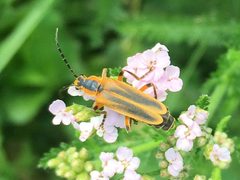
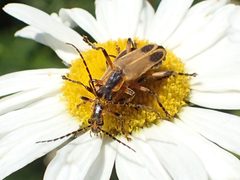
Chauliognathus marginatus is a soldier beetle ( Cantharidae) distributed across North and Central America. are and strongly associated with flowers, particularly white-blooming . A 2023 study using iNaturalist data demonstrated that this species exhibits statistically significant color preference for white flowers compared to availability, distinguishing it from the closely related Chauliognathus pensylvanicus which prefers yellow flowers. Both larvae and adults are predatory, contributing to of pest insects.
Pronunciation
How to pronounce Chauliognathus marginatus: //kaʊljəɡˈneɪθəs mɑrdʒɪˈneɪtəs//
These audio files are automatically generated. While they are not always 100% accurate, they are a good starting point.
Identification
can be distinguished from Chauliognathus pensylvanicus by association with white flowers versus yellow flowers, though this is a probabilistic rather than absolute character. The two overlap broadly in distribution and . Chauliognathus marginatus shows less specialization in flower use than C. pensylvanicus, utilizing a wider variety of plant families beyond Asteraceae. Definitive identification to species level may require examination of genitalia or other subtle morphological characters not visible in field observations.
Images
Appearance
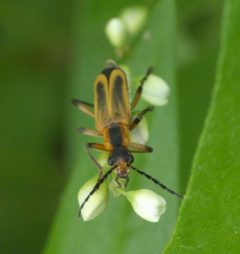
are elongate beetles with soft, flexible (wing covers) that give the group its 'leatherwings.' Coloration includes dark brown to black with orange, red, or yellow markings; the specific pattern of marginal markings on the elytra contributes to the name. are 11-segmented, threadlike, and typically held forward of the body. The pronotum is wider than the and wider than long. Body length ranges approximately 10–15 mm. Larvae are dark gray, velvety, and covered with fine hairs.
Habitat
Found in open including prairies, meadows, and gardens where flowering plants are abundant. are strongly associated with flowers for feeding and mating. Larvae occur in soil, leaf litter, and beneath loose bark, where they hunt ground-dwelling insects.
Distribution
North America and Central America. Records include the United States, Canada (New Brunswick), and Middle American countries. Within North America, occurs across a broad range including the Great Plains and other regions with suitable flower resources.
Seasonality
are active in spring and early summer, with peak activity coinciding with bloom periods of preferred white flowers. Larvae overwinter in soil or protected locations and pupate to emerge as adults the following spring.
Diet
feed on nectar, pollen, and small soft-bodied insects including aphids and caterpillars. Larvae are predatory on ground-dwelling insects and will ascend plants to hunt prey in flowers and on foliage.
Host Associations
- Asteraceae - flower visitationStrongly preferred ; frequently observed on composite flowers, particularly white-blooming
Life Cycle
Complete . laid in soil or litter. Larvae develop through multiple instars, overwinter, and pupate in spring. emerge and are active during daylight hours.
Behavior
activity pattern centered on flower visitation. engage in frequent mating on flowers. When disturbed, adults may withdraw legs and drop to the ground in (death feigning). Exhibits statistically significant preference for white flowers over expected availability based on local flora.
Ecological Role
contribute to pollination through flower visitation and serve as of soft-bodied plant pests. Larvae are important ground-dwelling predators that help regulate of soil and litter-dwelling insects. Both life stages function as agents in agricultural and garden settings.
Human Relevance
Considered beneficial in gardens and agricultural systems due to on aphids and other pests. Does not damage crops or structures. Subject of citizen science documentation through platforms like iNaturalist, where it has accumulated over 23,000 observations.
Similar Taxa
- Chauliognathus pensylvanicusOverlaps in distribution and ; distinguished by strong preference for yellow flowers versus white flowers in C. marginatus, though both use Asteraceae heavily. C. pensylvanicus shows more specialized flower use.
- Chauliognathus limbicollisSimilar ; western distribution (Arizona, Colorado, New Mexico, Texas) versus broader North American range of C. marginatus.
More Details
Citizen Science Research
A 2023 study in Annals of the Entomological Society of America used over 23,000 iNaturalist observations to demonstrate -specific flower color preferences in C. marginatus, representing the first use of -gathered digital specimens to address species-specific behavioral and ecological questions in entomology.
Sources and further reading
- BugGuide
- Wikipedia
- GBIF taxonomy match
- iNaturalist taxon
- NCBI Taxonomy
- Entomologists Did These! | Bug Squad
- Pixelated Entomology: Analyzing Beetles' Flower Use Through Digital Samples
- Soggy death to friendly soldiers: Soldier beetles, Chauliognathus pennsylvanicus, and their deadly fungus, Entomophthora lampyridarum — Bug of the Week
- Green Light: New ID Test Ready for Invasive Mealybug Pest
- 9th Annual Fall Tiger Beetle Trip: Day 2 | Beetles In The Bush
- Why Augmentative Biological Control Holds Promise for Advancing Agriculture in Developing Countries