
Podabrus pruinosus
LeConte, 1851
downy leather-winged beetle
Species Guides
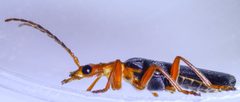
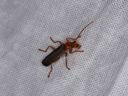
5Podabrus pruinosus, commonly known as the downy leather-winged , is a soldier beetle in the Cantharidae. measure 9–15 mm in length and are distinguished by their orange bodies with black-brown, finely hairy wing covers. The is active during spring and summer, when adults have been observed feeding on aphids. Larvae are larger than adults, reaching 15–20 mm, and live in soil.

Pronunciation
How to pronounce Podabrus pruinosus: /poˈda.brus pruˈi.no.sus/
These audio files are automatically generated. While they are not always 100% accurate, they are a good starting point.
Identification
Distinguished from other soldier beetles by the combination of orange body with black-brown, finely hairy () wing covers. The downy texture of the is particularly notable. When disturbed, drop to the ground and feign death—a useful for field identification. The larger size and pink coloration with two dark thoracic stripes distinguish larvae from many other larvae.
Images
Appearance
are 9–15 mm in length with orange bodies. The wing covers () are black-brown and covered in fine hair, giving the its "downy leather-winged ." The is typically bent downward. are 11-segmented and threadlike, held forward of the body. The pronotum is wider than the head and wider than long. The wing covers appear velvety, soft, and flexible—characteristic of leatherwings. Larvae are 15–20 mm long, pink in color, with two dark lines on the .
Habitat
are commonly found on flowers and leaves infested with aphids or other honeydew-excreting insects. Larvae inhabit soil.
Distribution
North America. The has been recorded across the continent, with specific observations from Oklahoma (Woodward County, Major County, Beaver County, Cimarron County) and other regions.
Seasonality
Active in spring and summer. have been observed from at least May through August, with peak activity likely corresponding to availability.
Diet
feed on aphids. Larval diet is not explicitly documented in available sources.
Life Cycle
Larvae are 15–20 mm long, pink, with two dark lines on the , and live in soil. Details of and -laying are not documented in available sources.
Behavior
When disturbed, withdraw their legs and drop to the ground, appearing dead (). Adults are and frequently observed on flowers or foliage. Larvae are soil-dwelling.
Ecological Role
are predatory on aphids, potentially contributing to natural pest suppression. The serves as prey for various vertebrate , though its coloration signals chemical defense.
Human Relevance
May provide incidental of aphids in gardens and agricultural settings. No significant negative impacts documented. and larvae can excrete noxious defensive chemicals from specialized abdominal glands, making them distasteful to .
Similar Taxa
- Other Podabrus speciesShare orange and black coloration pattern; P. pruinosus distinguished by finely hairy () wing covers
- Chauliognathus limbicollisAnother cantharid soldier beetle found on flowers; differs in color pattern and lacks the downy wing texture
- Cantharis speciesSimilar body form and use; P. pruinosus distinguished by specific orange-and-black pattern with
More Details
Subspecies
Five are recognized: P. p. atrocervicus Fender, 1962; P. p. comes; P. p. diversipes Fall, 1927; P. p. gradatus; and P. p. pruinosus (nominate subspecies).
Chemical defense
Like other cantharids, and larvae possess specialized abdominal glands that produce noxious defensive compounds, making them unpalatable to . This is advertised by their aposematic (warning) coloration.
Taxonomic note
GBIF flags this as 'DOUBTFUL' in status, suggesting possible taxonomic uncertainty requiring verification.
Sources and further reading
- BugGuide
- Wikipedia
- GBIF taxonomy match
- iNaturalist taxon
- Entomologists Did These! | Bug Squad
- Ants in the Nest: A Possible Emerging Pressure on Sea Turtles
- Periodical Cicadas, 2024: Entomologists Prepare for the Six-Week Serenade
- A “superb” southwestern Missouri cicada | Beetles In The Bush
- Bug Eric: Wasp Wednesday: Pacific Cicada Killer
- August “jug trap” run | Beetles In The Bush