
Cantharis rufa
Linnaeus, 1758
soldier beetle
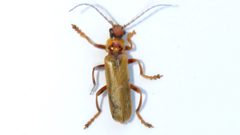
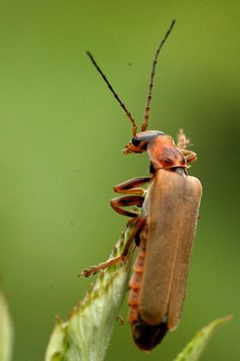
Cantharis rufa is a soldier beetle ( Cantharidae) measuring 8–11 mm in length. It is widely distributed across the Palaearctic region and has been introduced to North America, where it is expanding its range. The has an with two 'prolarval' and six larval instars. are active from mid-May to mid-July.
Pronunciation
How to pronounce Cantharis rufa: /ˈkanθaˌris ˈruːfa/
These audio files are automatically generated. While they are not always 100% accurate, they are a good starting point.
Identification
Distinguished from other Cantharis by the large basal tooth on the front claw of the foreleg and the bilobed third tarsal segment on the mid and hind legs. The flattened, widened last segment of the maxillary palpi is also diagnostic. The weakly sclerotised, flexible separate Cantharidae from most other . A peculiar striped elytra form occurs in Central Asia, Siberia, and China.
Images
Appearance
Elongate body, 8–11 mm in length. Simple, weakly sclerotised that are soft and flexible (giving rise to the 'leatherwings'). Flattened and widened last segment of maxillary palpi. Bilobed third tarsal segment on mid and hind legs. Front claw with large basal tooth on front leg. Coloration typically dark brown to black with orange, red, or yellow markings. 11-segmented, threadlike, commonly held forward of body. Pronotum wider than and wider than long. Head commonly bent downward.
Habitat
occur in open lowland , marshy sites, saltmarshes, deciduous woodlands, parks, and hedgerows. Larval habitats include soil, under logs, on , and on snow.
Distribution
Native to the Palaearctic region, including Britain (common in England and Wales, scattered in Scotland). Introduced to the Nearctic region (USA and Canada: Newfoundland west to Ontario, south to Massachusetts, New York and northern Appalachians), with ongoing range expansion to Manitoba.
Seasonality
active from mid-May to mid-July. Larvae present year-round in soil and litter; often observed on snow during winter ('snow-worms').
Diet
Larvae are of small soil and litter-dwelling animals but can also feed on plant matter; successfully reared on soaked wheat grains and other plant materials in laboratory. are omnivores, preying on small and feeding on plants.
Life Cycle
with two 'prolarval' ('Vorlarvenstadien') stages followed by six larval instars.
Behavior
Larvae often called 'snow-worms' due to being found active on snow during winter. When disturbed, may withdraw their legs and drop to the ground as if dead. Adults are and commonly observed on flowers or leaves infested with aphids or other honeydew-excreting insects. Adults and larvae can excrete noxious, defensive chemicals from specialized abdominal glands.
Ecological Role
Human Relevance
are beneficial in gardens and agricultural settings as of aphids. The has been used in genomic research; its was sequenced as part of the Darwin Tree of Life project.
Similar Taxa
- Cantharis lividaSimilar coloration and body form; distinguished by differences in male genitalia and tarsal structure.
- Cantharis fuscaOverlapping distribution and use; C. rufa distinguished by the large basal tooth on the front claw.
- Chauliognathus speciesOther common soldier beetle in some regions; Chauliognathus typically have different color patterns and lack the diagnostic front claw tooth of C. rufa.
More Details
Genomic Resources
sequenced as part of the Darwin Tree of Life project (Wellcome Sanger Institute, 2024). Genome assembly available with explicit methods documented.
Introduced Range
Established in northeastern North America; first recorded in Newfoundland, now expanding westward to Manitoba and south to the northern Appalachians.
Etymology
The 'soldier beetle' refers to the resemblance of the red and black coloration to the red coats of British soldiers during the American Revolution.