
Carphoborus
Eichhoff, W.J., 1864
Species Guides
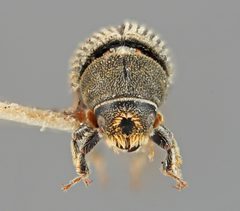
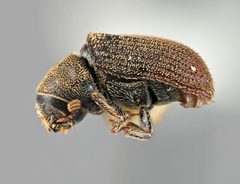
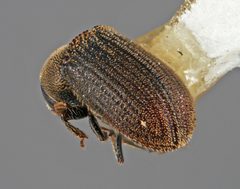
7Carphoborus is a of crenulate bark beetles in the Curculionidae, containing at least 40 described . Members of this genus are associated with coniferous forests and are recognized as forest pests in some regions. One species, Carphoborus minimus, has been studied for its potential northward range expansion in Turkey due to climate change.
Pronunciation
How to pronounce Carphoborus: /ˌkaɹfɒˈbɔːɹəs/
These audio files are automatically generated. While they are not always 100% accurate, they are a good starting point.
Identification
Crenulate bark beetles can be distinguished from other bark beetle by the presence of crenulate (scalloped or notched) elytral declivity. Specific identification of Carphoborus requires examination of microscopic characters including pronotal and elytral punctation, antennal club structure, and male genitalia.
Images
Habitat
Coniferous forests, particularly pine stands. In Turkey, suitable for Carphoborus minimus occurs in western and southern Anatolia, with potential for expansion to northern Anatolia under future climate scenarios.
Distribution
Recorded from Norway and Sweden. -level distributions vary; Carphoborus minimus currently occurs in western and southern Anatolia with predicted expansion to northern Anatolia in the 2050s and 2090s.
Host Associations
- pine - Associated with pine stands in Turkey; specific relationships at level not documented
Ecological Role
Forest pest; potential threat to pine forests in expanding range areas.
Human Relevance
Forestry concern in Turkey, where climate change may expand suitable and increase threat to northern pine stands. State forestry authorities are advised to take precautions in affected regions.
Similar Taxa
- other crenulate bark beetle generaShared Curculionidae and crenulate elytral declivity; distinguished by specific morphological characters of pronotum, , and genitalia
- other bark beetle genera in CurculionidaeSimilar size and habits; distinguished by presence of crenulate (scalloped) elytral declivity characteristic of this
More Details
Climate change impact
Modeling studies indicate that Carphoborus minimus distribution in Turkey may increase 7-13.5% by 2081-2100 under SSP2 and SSP5 emission scenarios, with key bioclimatic drivers being temperature seasonality, isothermality, and precipitation of the driest quarter.