
Eustenopus villosus
(Boheman, 1843)
yellow starthistle hairy weevil
Eustenopus villosus is a small weevil in the Curculionidae, widely known as the yellow starthistle hairy weevil. It is native to southern Europe and the Mediterranean region and has been introduced to the western United States as a agent against the weed yellow starthistle (Centaurea solstitialis). Both and larvae feed on the plant's reproductive structures, with larvae capable of destroying nearly all developing seeds within a single flower . The is considered one of the more effective biocontrol agents for this noxious weed.
Pronunciation
How to pronounce Eustenopus villosus: /juːˈstɛnəpəs vɪˈloʊsəs/
These audio files are automatically generated. While they are not always 100% accurate, they are a good starting point.
Identification
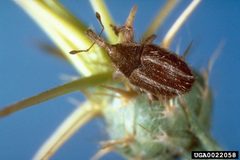
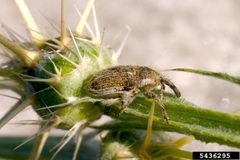
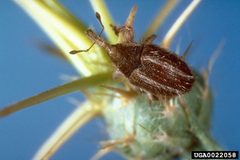
are 4–6 mm in length, not including the elongated rostrum. The body is densely covered with hairs and brown in color with white stripes. The long snout is a distinctive feature of this and other true weevils. The visible oviposition hole sealed with dark mucilage on flower may aid in detection.
Images
Habitat
Strictly associated with yellow starthistle (Centaurea solstitialis). are found on young and late-stage buds, capitula, and stems of the plant. The has been observed in both natural and disturbed where the host weed occurs.
Distribution
Native to southern Europe and the Mediterranean region. Introduced and established in the western United States, where it occurs wherever yellow starthistle grows. First released in the United States in 1990.
Diet
feed on young buds, capitula, and stems of yellow starthistle. Feeding bouts typically last over one hour. Larvae feed on developing ovaries and achenes within the flower , capable of destroying all or nearly all seeds in just over two weeks.
Host Associations
- Centaurea solstitialis - primary yellow starthistle; sole documented for feeding, oviposition, and larval development
- invasive Centaurea species - additional has been observed to attack other Centaurea , though specificity details are limited
Life Cycle
Postdiapausal emerge and feed before . The female chews a hole in a closed flower , deposits a single inside, and seals the hole with dark-colored mucilage. The larva emerges in approximately three days and feeds on flower parts and developing seeds for slightly more than two weeks. It then constructs a pupal chamber within the flower head using feeding debris, pupates for one to two weeks, and emerges as an adult. Both larvae and adults contribute to plant damage.
Behavior
Feeding follows a stereotyped sequence: explore, feed, then budwalk. Oviposition includes a distinct sequence: exploring, feeding (often lasting approximately 2 hours to prepare the oviposition cavity), turning, ovipositing, and budwalking. Both sexes engage in postdiapausal feeding. The is considered especially destructive on a per-insect basis due to the combined feeding damage of and larvae.
Ecological Role
herbivore and effective agent for the weed yellow starthistle. Reduces seed production of the plant through larval seed and bud feeding. Has not been documented to damage native flora.
Human Relevance
Intentionally introduced and established as a agent for yellow starthistle in the western United States since 1990. Considered one of the more efficient biocontrol agents for this weed.
Similar Taxa
- other yellow starthistle biocontrol agentsmultiple insects have been introduced for yellow starthistle control; E. villosus is distinguished by its small size, hairy appearance, and specific feeding damage patterns on buds and seeds
- other Larinus/Eustenopus weevilscongeneric or related weevils may share general ; E. villosus is distinguished by its specific association with yellow starthistle and its particular color pattern of brown with white stripes
Sources and further reading
- BugGuide
- Wikipedia
- GBIF taxonomy match
- iNaturalist taxon
- NCBI Taxonomy
- Urban Wonder: Rare Butterfly Thrives in One of Ecuador's Largest Cities
- Oedemeridae | Beetles In The Bush
- Lake Tahoe, California | Beetles In The Bush
- Life History of Eustenopus villosus (Coleoptera: Curculionidae), a Promising Biological Control Agent for Yellow Starthistle
- Laboratory and Field Observations of the Behavior of Eustenopus villosus while Feeding and Ovipositing on Yellow Starthistle