
Lixini
Genus Guides
4- Eustenopus
- Larinus
- Lixus
- Microlarinus(puncturevine seed weevils)
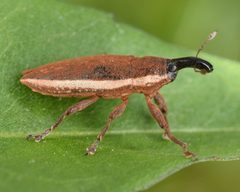
Lixini is a tribe of weevils (Curculionidae: Lixinae) containing approximately 150 in several , most notably Lixus. Members are characterized by elongated bodies and are primarily associated with Asteraceae plants. Larvae are stem-borers, developing inside host plant stems where they feed on parenchymal tissue. The tribe has a wide distribution across the Palaearctic, Afrotropical, and other regions, with significant diversity in southern Africa.


Pronunciation
How to pronounce Lixini: //lɪkˈsiːnaɪ//
These audio files are automatically generated. While they are not always 100% accurate, they are a good starting point.
Identification
Images
Distribution
Widely distributed across the Palaearctic region, with significant diversity in southern Africa. The Tricholarinus is to southern Africa.
Diet
Larvae feed on parenchymal pith tissue of plant stems. Specific dietary habits of are not documented in available sources.
Host Associations
- Cirsium serrulatum - larval Stem-boring larvae develop in stems
- Carduus acanthoides - larval Stem-boring larvae develop in stems
- Berkheya - associationAt least some of Tricholarinus associated with this Asteraceae
Life Cycle
Larvae develop inside plant stems, creating elongated tunnels progressing from base to apex. In Lixus pulverulentus, larval tunnels reach approximately 30 cm in length. occurs within the host stem. Complete time and longevity are not documented.
Behavior
Larval tunneling progresses upward from stem base to apex. Larvae may exhibit spatial partitioning with co-occurring cerambycid beetles, with Lixini larvae occupying upper stem sections while competitors occupy lower sections. Competitive suppression by larger cerambycid larvae has been observed.
Ecological Role
Stem-borers in Asteraceae, particularly thistles. Larval feeding causes stem withering from base to apex but typically does not affect seed formation. May compete with other stem-boring insects for resources.
Similar Taxa
More Details
Larval Morphology
Lixini larvae are cream-white with light brown pronotal areas; pupae are pale yellow and slender with in rostrum length. Larval and pupal morphological have been updated based on detailed studies of Lixus .
Taxonomic Activity
Recent taxonomic work has described new and from southern Africa, including the genus Tricholarinus with ten new species and five transferred species, highlighting ongoing revision of the tribe's classification.
Sources and further reading
- BugGuide
- iNaturalist taxon
- NCBI Taxonomy
- Catalogue of Life
- A new Lixini genus from southern Africa with description of ten new species (Coleoptera: Curculionidae)
- Descriptions of immature stages of the weevil Lixus punctiventris Boheman, 1835 (Coleoptera, Curculionidae, Lixini)
- Description of the preimaginal stages and biology of the weevil Lixus (Dilixellus) pulverulentus (Scopoli, 1763) (Coleoptera: Curculionidae: Lixini)