
Hypera nigrirostris
(Fabricius, 1775)
lesser clover leaf weevil, black-beaked green weevil
Hypera nigrirostris, commonly known as the lesser clover leaf weevil, is a small curculionid native to Europe and northern Africa that has been introduced to North America and Japan. It is a specialized herbivore of leguminous plants, particularly red clover (Trifolium pratense), and has become a significant agricultural pest in red clover seed production systems where larval feeding can reduce yields by up to 50%.
Pronunciation
How to pronounce Hypera nigrirostris: /haɪˈpɛɹə nɪɡˌrɪˈrɒstrɪs/
These audio files are automatically generated. While they are not always 100% accurate, they are a good starting point.
Identification
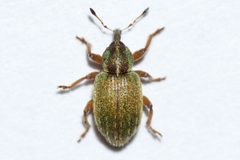
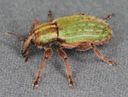
Distinguished from similar Hypera by the combination of: rostrum length-to-width ratio of 3:1 with basal notch; greenish metallic and pronotum sheen from dissected ; small size (3–4 mm); and black body with reddish appendages. The prominent humeral humps on the elytra and the relatively broad pronotum compared to width are additional diagnostic characters. In agricultural settings, presence in red clover fields during the growing season provides ecological context.
Images
Habitat
Agricultural and semi-natural dominated by Fabaceae, particularly red clover (Trifolium pratense) fields. overwinter within red clover fields in temperate regions. The requires environments supporting its plants through the growing season, from spring through late summer .
Distribution
Native to Europe and northern Africa; introduced and established in North America and Japan. Within North America, documented in agricultural regions of Canada (northeastern Saskatchewan) and the United States, with presence in all lower 48 states inferred from agricultural pest records. GBIF records confirm presence in Belgium and North America.
Seasonality
become active in late April to early May following . Oviposition occurs from early May through mid-July. Larval development spans early June to mid-August, with four instars. from late June to August. New- adults emerge from mid-July, causing sharp increases. Seasonal activity is tightly coupled to red clover .
Diet
Oligophagous on Fabaceae. Primary are red clover (Trifolium pratense), white clover (T. repens), and alsike clover (T. hybridum). Secondary hosts include pea, alfalfa, and vetch. chew holes in leaves and create hollows in stems. Larvae feed on stipules, buds, and inflorescences, with each larva damaging three to four flower during development.
Host Associations
- Trifolium pratense - primary red clover; main in agricultural systems
- Trifolium repens - primary white clover
- Trifolium hybridum - primary alsike clover
- Pisum sativum - secondary pea
- Medicago sativa - secondary alfalfa
- Vicia - secondary vetch
Life Cycle
emerge in late April–early May and immediately begin feeding, mating, and oviposition. are laid subepidermally in stipules, shoots, and leaves from early May to mid-July. Larvae hatch and develop through four instars while feeding on stipules, buds, and inflorescences, present from early June to mid-August. occurs on plant stems or in ground debris from late June through August. New adults emerge from mid-July, with densities increasing sharply. Spatial distribution of eggs and larvae is aggregated, becoming less clumped as larvae develop.
Behavior
exhibit aggregated spatial distribution patterns for oviposition, with and young larvae clustered on plants. Adults are capable of in situ within host plant fields rather than dispersing to protected sites. New- adults show synchronized in mid-July, creating detectable surges. Larvae are relatively sedentary, remaining on the same plant or inflorescence through development.
Ecological Role
Herbivore and agricultural pest in legume cropping systems. In its native range, likely functions as a regulator of wild clover . In introduced regions, has become a significant economic pest of red clover seed production. Natural control in Canada has been observed through insects and fungi, though these are insufficient for economic management in agricultural settings.
Human Relevance
Major pest of red clover seed production in North America, with documented yield losses up to 50% from larval feeding. and have been developed for in red clover seed systems. Management strategies include early harvest, grazing, -plant resistance, chemical control (with safety concerns), and through . Prophylactic use has been common due to lack of established thresholds, creating risks of resistance development and pollinator harm.
Similar Taxa
- Hypera posticaAlfalfa weevil; larger with different rostral proportions and coloration, primarily attacks alfalfa rather than clover, and has a more western North American distribution
- Other Hypera speciesDistinguished by the unique combination of rostrum proportions (3:1 length:width with basal notch), greenish metallic coloration, and specific associations with Trifolium
More Details
Economic Impact
The first data-driven for North American red clover seed systems were established in 2024, providing foundation for cost-effective, -conscious management strategies.
Taxonomic Note
Originally described as Apion nigripes; current combination in Hypera reflects revised generic placement within Curculionidae.
Sources and further reading
- BugGuide
- Wikipedia
- GBIF taxonomy match
- iNaturalist taxon
- NCBI Taxonomy
- Catalogue of Life
- Shedding New Light on Honey Bee Chromosomes | Bug Squad
- Who's Speaking at the UC Davis Entomology/Nematology Seminars? | Bug Squad
- Waxy lady beetles come to the rescue of pest-plagued crapemyrtles, Hyperaspis spp. — Bug of the Week
- Alfalfa Weevil: New Integrated Pest Management Guide Available
- Uncategorized | Blog - Part 23
- Beware the bee fly - Bombylius sp. — Bug of the Week
- Unusual Host Records for Gymnaetron pascuorum, Hexarthrum ulkei, Chalcodermus aeneus, and Hypera nigrirostris (Coleoptera: Curculionidae)
- Economic thresholds for Hypera nigrirostris (Coleoptera: Curculionidae) in red clover seed production from on-farm trials
- THE BIOLOGY OF THE LESSER CLOVER LEAF WEEVIL, HYPERA NIGRIROSTRIS (FABR.) (COLEOPTERA: CURCULIONIDAE), ON RED CLOVER, TRIFOLIUM PRATENSE L., IN SASKATCHEWAN