
Oxyops vitiosus
Pascoe, 1870
Melaleuca Weevil
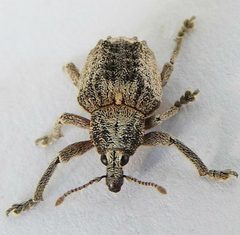
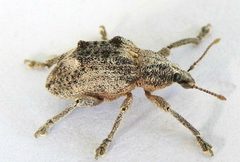
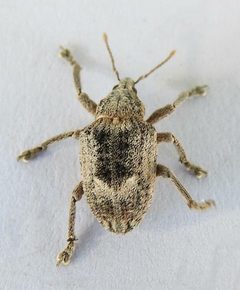
Oxyops vitiosus, commonly known as the Melaleuca Weevil, is a of broad-nosed weevil in the Curculionidae. It is native to Australia and has been introduced to the United States as a agent targeting Melaleuca trees. The species is notable for its specialized feeding relationship with plants in the Melaleuca.
Pronunciation
How to pronounce Oxyops vitiosus: /ˈɒksiˌɒps vɪˈtaɪəsəs/
These audio files are automatically generated. While they are not always 100% accurate, they are a good starting point.
Identification
Can be distinguished from other Oxyops by association with Melaleuca plants in areas where it has been introduced. As a member of Gonipterini, shares the tribe's characteristic broad rostrum and compact body form typical of broad-nosed weevils. Specific morphological diagnostic features require examination.
Images
Habitat
Associated with Melaleuca wetlands, swamps, and disturbed sites where plants occur. In its native Australian range, inhabits natural Melaleuca-dominated . In introduced range (southeastern United States), found in areas of Melaleuca quinquenervia invasion, particularly in Florida wetlands.
Distribution
Native to Australia. Introduced and established in the United States, specifically in Florida and potentially other southeastern states where Melaleuca quinquenervia occurs.
Diet
feeder on Melaleuca , particularly Melaleuca quinquenervia (paperbark tree). Both larvae and feed on plant tissues.
Host Associations
- Melaleuca quinquenervia - plantPrimary ; target of introduction in United States
- Melaleuca - plant-level association in native Australian range
Life Cycle
Complete with , larval, pupal, and stages. Larvae develop in association with plant tissues. Specific developmental timing and details of site require further documentation.
Ecological Role
Herbivore and agent. In introduced range, functions as a suppressor of Melaleuca quinquenervia, contributing to wetland restoration efforts. In native range, part of natural Melaleuca herbivore .
Human Relevance
Intentionally introduced to the United States for of Melaleuca quinquenervia, an tree that threatens Florida Everglades . Represents a case of purposeful international transport for conservation biocontrol.
Similar Taxa
- Oxyops vittatusCongeneric ; distinction requires examination of elytral pattern and other subtle morphological features
- Gonipterus scutellatusMember of same tribe Gonipterini with similar Melaleuca-feeding ; differs in more elongated body form and distinct
More Details
Biological Control History
Introduced to Florida in 1997 as part of a multi-agent program against Melaleuca quinquenervia. Establishment and efficacy monitoring have been conducted by USDA and state agencies.
Taxonomic Note
Authored by Francis Pascoe in 1870, with original description based on Australian material. The specific epithet 'vitiosus' (Latin: faulty, defective) may refer to perceived irregularities in .