
Otiorhynchus cribricollis
Gyllenhal, 1834
Cribrate Weevil, Apple Weevil
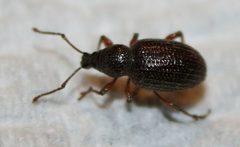
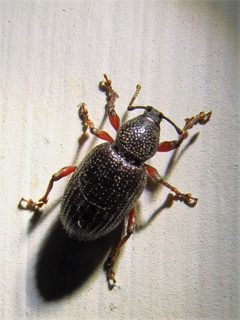
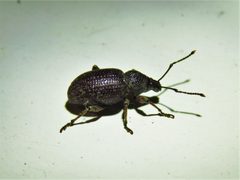
Otiorhynchus cribricollis, commonly known as the cribrate weevil or apple weevil, is a flightless weevil native to the Mediterranean region. It has been introduced to Western Australia, where it is recognized as a significant pest of apple orchards and vineyards. The reproduces through , with all individuals being female. It has also been recorded from North America (USA), though its establishment status there is less documented.
Pronunciation
How to pronounce Otiorhynchus cribricollis: /ˌəʊ.tiˈɒr.ɪŋ.kəs ˌkrɪ.brɪˈkɒl.ɪs/
These audio files are automatically generated. While they are not always 100% accurate, they are a good starting point.
Identification
The specific epithet 'cribricollis' refers to a punctured or sieve-like appearance of the pronotum (neck region), which may aid in distinguishing this from congeneric weevils. As a member of the Otiorhynchus, it possesses the characteristic elongated rostrum with elbowed typical of broad-nosed weevils. Definitive identification requires examination of genitalia or detailed morphological comparison with related species.
Images
Habitat
Native to Mediterranean climates; in Western Australia, has been observed in agricultural settings including apple orchards and vineyards. The original Mediterranean likely includes open woodlands, shrublands, and areas with plants.
Distribution
Native: Mediterranean region including southern Europe (France, Spain, Italy, Sicily, Balearic Islands, Gibraltar, Greece), central Europe (Austria, Germany, Hungary), North Africa (Morocco, Algeria, Tunisia, Libya, Egypt), and Turkey. Introduced: Western Australia, USA. Also recorded from some Atlantic islands (Azores: Corvo, Faial, Flores, Graciosa, Pico).
Diet
feed on: almonds, apples, citrus, lucerne (alfalfa), olives, plums, and grapevines. Specific feeding habits of larvae are not documented in available sources, though Otiorhynchus larvae are generally root-feeders.
Host Associations
- Malus domestica - pestapple orchards
- Vitis vinifera - pestvineyards
- Prunus dulcis - pestalmonds
- Citrus - pestcitrus
- Medicago sativa - pestlucerne/alfalfa
- Olea europaea - pestolives
- Prunus domestica - pestplums
Life Cycle
is parthenogenetic; all individuals are female. are flightless. Specific details regarding , larval, and pupal stages are not documented in available sources.
Behavior
are flightless, limiting to or human-mediated transport. occurs without males through .
Human Relevance
Recognized as an agricultural pest in Western Australia, causing damage to apple orchards and vineyards. The flightless condition and parthenogenetic may facilitate establishment in new regions through accidental transport.
Similar Taxa
- Otiorhynchus sulcatus (Black Vine Weevil)Also flightless, parthenogenetic, and a vineyard pest; distinguished by differences in pronotal sculpturing and distribution (O. sulcatus is more widespread globally, including Europe, North America, and New Zealand)
- Other Otiorhynchus speciesMany congeneric share the flightless, parthenogenetic ; accurate identification requires examination of the 'cribrate' (sieve-like) pronotal punctation characteristic of O. cribricollis
More Details
Parthenogenesis and invasion biology
The combination of parthenogenetic and flightlessness in O. cribricollis represents a common trait in Otiorhynchus weevils. This reproductive mode ensures that a single individual can found a new , while flightlessness reduces local but increases likelihood of human-mediated transport in soil or plants.
Taxonomic note
Listed as a synonym in some sources (Catalogue of Life), but accepted in GBIF and NCBI. The alternate combination Brachyrhinus cribricollis appears in older literature.