
Philopedon
Schönherr, 1826
broad-nosed weevils
Species Guides
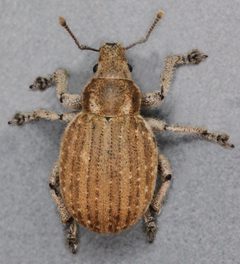
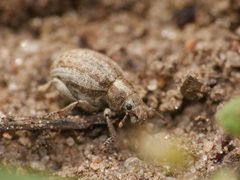
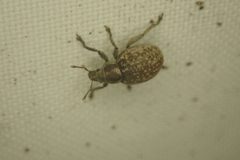
1- Philopedon plagiatum(marram weevil)
Philopedon is a of broad-nosed weevils in the Curculionidae, established by Schönherr in 1826. The genus contains approximately seven described distributed primarily across Europe and North Africa. One species, Philopedon plagiatum, is commonly known as the marram weevil due to its association with marram grass (Ammophila arenaria). The genus belongs to the tribe Cneorhinini within the Entiminae.
Pronunciation
How to pronounce Philopedon: //ˌfɪloʊˈpiːdən//
These audio files are automatically generated. While they are not always 100% accurate, they are a good starting point.
Identification
As a member of the tribe Cneorhinini, Philopedon possess the characteristic broad, short rostrum (snout) typical of broad-nosed weevils, distinguishing them from long-nosed weevils with elongated rostra. Species-level identification within the requires examination of genitalia and subtle external morphological features. The genus is distinguished from related Cneorhinini genera by specific combinations of elytral , leg spination, and body proportions, though these characters are not detailed in available sources.
Images
Habitat
in this are associated with coastal and sandy environments. Philopedon plagiatum, the marram weevil, is specifically linked to dune systems where its plant marram grass grows. Other species occur in similar open, sandy in the Mediterranean region.
Distribution
The has a Palearctic distribution centered on Europe and North Africa. Distribution records include Denmark (DK) and Algeria (DZ). Individual show more restricted ranges: P. plagiatum occurs in coastal Europe, while P. espagnoli and P. lasierrae are known from Spain, and P. tuniseum from Tunisia.
Diet
Philopedon plagiatum feeds on marram grass (Ammophila arenaria). Diet of other in the has not been documented in available sources.
Host Associations
- Ammophila arenaria - food plant of Philopedon plagiatum
Human Relevance
Philopedon plagiatum has been investigated as a potential agent for marram grass in regions where this grass is , such as New Zealand and Australia, though it is also valued for dune stabilization in its native range.
Similar Taxa
- CneorhinusBoth belong to tribe Cneorhinini and share the broad-nosed weevil ; distinguished by genitalic and external structural characters not specified in available sources
- OtiorhynchusBroad-nosed weevil in same Entiminae; distinguished by tribal placement (Otiorhynchini vs. Cneorhinini) and associated morphological characters
More Details
Species list
The contains seven described : Philopedon consentaneum, P. depilatum, P. espagnoli, P. lasierrae, P. plagiatum, P. tuniseum, and P. vicinum
Taxonomic history
Authorship is sometimes cited as Schoenherr or Schönherr, 1826; the original spelling is Schönherr