
Anypotactini
Champion, 1911
Genus Guides
1- Polydacrys(broad-nosed weevils)
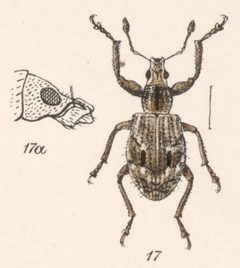
Anypotactini is a Neotropical weevil tribe in the Entiminae, comprising 81 described across 13 . The tribe is characterized by small body size and distinctive coverage. Its modern distribution spans from the southwestern United States to southern South America, with the highest diversity in Central America and northern South America. The tribe has also been documented from Eocene deposits in Europe, indicating a broader historical distribution during warmer climatic periods.
Pronunciation
How to pronounce Anypotactini: /ˌænɪpoʊˈtæktɪnaɪ/
These audio files are automatically generated. While they are not always 100% accurate, they are a good starting point.
Identification
Distinguished from other Entiminae tribes by the combination of small size (4–11 mm), brown or metallic coverage, and the presence of thick, erect scale-like setae on the surface. The Hyphantus is notably larger and darker, while Prepodellus may show metallic green or blue scales. The tribe can be separated from Eudiagogini, with which it shares some biogeographic history, by morphological characters of the and setation.
Images
Habitat
Associated with Neotropical forest environments; the presence of Anypotactini in Eocene European deposits suggests to temperate forest conditions comparable to modern Valdivian temperate forests.
Distribution
Modern distribution: southwestern USA (Texas) through Mexico, Central America, and South America to Argentina and Chile, plus some Caribbean islands. Most concentrated in Central America and northern South America; genus Hyphantus (45 ) restricted to southern Brazil, Argentina, Paraguay, and Uruguay. Historical distribution: present in Eocene Europe (Rovno amber, Late Eocene).
Human Relevance
Fossil serve as paleoclimatic indicators; the tribe's presence in Eocene European amber helps reconstruct past forest conditions and transcontinental patterns.
Similar Taxa
- EudiagoginiShares Eocene European fossil record and similar biogeographic history; distinguished by morphological differences in and setation
More Details
Fossil Record
Three of Paonaupactus documented from Late Eocene Rovno amber, including Paonaupactus zosimovichi described in 2022, characterized by rarer decumbent on elytral interstriae and smaller body size compared to P. gracilis
Taxonomic History
Central American studied by Champion (1911), who established the tribal classification; the tribe's authorship is attributed to Champion, 1911