
Listroderes
Schoenherr, C.J., 1826
vegetable weevils
Species Guides
3- Listroderes apicalis(underwater weevil)
- Listroderes costirostris(vegetable weevil)
- Listroderes difficilis(difficult weevil)
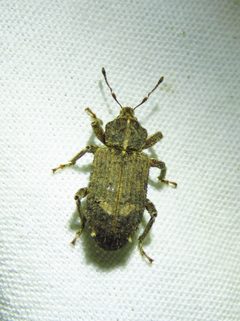
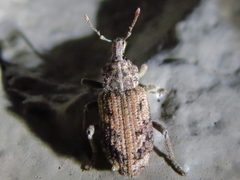
Listroderes is a of weevils in the Curculionidae, Cyclominae. The genus includes at least 170 described , though some sources suggest a smaller core group. Several species, particularly Listroderes costirostris (vegetable weevil), are significant agricultural pests with broad ranges. The genus is characterized by distinctive body vestiture of subcircular to suboval . Species are native to southern South America, with some introduced widely through human activity.
Pronunciation
How to pronounce Listroderes: //ˌlɪs.trəˈdɪər.iːz//
These audio files are automatically generated. While they are not always 100% accurate, they are a good starting point.
Identification
Members of Listroderes can be distinguished by body vestiture consisting of subcircular to suboval —a synapomorphy defining the as monophyletic. The genus is further characterized by features of external and male and female genitalia. -level identification requires examination of genital structures and subtle morphological characters; the genus has been divided into species groups (curvipes, nodifer, robustus, costirostris) based on these features.
Images
Distribution
The is to southern South America, with centers of diversity in central Chile, sub-Antarctic regions, central Argentina, and the Chaco. At least one , Listroderes costirostris, has been introduced to multiple continents and is now present in Europe (France, Portugal, Spain), Asia (Japan, Korea, Taiwan), Africa (Morocco, South Africa), North America (USA, Hawaii), Oceania (Australia, New Zealand, New Caledonia, Norfolk Island), and additional South American locations.
Behavior
of at least one (Listroderes obliquus) use vibration mechanisms of the maxillary palpi during food searching, indicating specialized sensory for plant location.
Human Relevance
Listroderes costirostris, the vegetable weevil, is a significant agricultural pest attacking a wide range of vegetables and weeds. It has been introduced to multiple continents, prompting efforts. were introduced to Australia from Uruguay and Argentina between 1957–1968, including Stomatomyia littoralis (Tachinidae) and Tersilochus argentinensis and T. parkeri (Ichneumonidae).
Similar Taxa
- HyperoidesUsed as outgroup in phylogenetic analyses; distinguished from Listroderes by plesiomorphic character states and lack of the distinctive subcircular to suboval body .
More Details
Taxonomic Discrepancy
Sources conflict on count: Wikipedia states 'more than 170 described species,' while a 1993 cladistic analysis recognized 35 species as to southern South America, and iNaturalist suggests 'about five described species.' This likely reflects different taxonomic treatments or inclusion of synonymized names.
Biogeographic History
The distribution pattern of Listroderes reflects vicariance associated with Andean uplift (Oligocene-Pliocene), which caused progressive aridification and replacement of ancient subtropical forest by open-country environments.
Sources and further reading
- BugGuide
- Wikipedia
- GBIF taxonomy match
- iNaturalist taxon
- NCBI Taxonomy
- Catalogue of Life
- Listroderes costirostris . [Distribution map].
- Listroderes costirostris . [Distribution map].
- CLADISTIC AND BIOGEOGRAPHIC ANALYSES OF THE WEEVIL GENUS LISTRODERES SCHOENHERR (COLEOPTERA: CURCULIONIDAE)
- The introduction into Australia of parasites of Listroderes obliquus Klug
- Spatial Distribution of Listroderes costirostris and Hypera postica (Curculionidae: Cyclominae, Hyperinae) on a Celery Crop in Mexico's Northwest Region
- Vibration Mechanisms of Maxillary Palpi in the Vegetable Weevil Adult, Listroderes obliquus KLUG (Coleoptera : curculionidae) during Food Searching : Studies on the Host Plant Determination of the Leaf-Feeding Insects VII