
Cyclominae
Tribe Guides
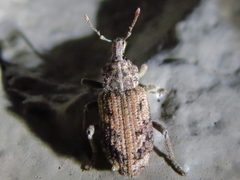
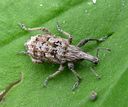
1Cyclominae is a of weevils (Curculionidae) comprising seven tribes: Amycterini, Aterpini, Cyclomini, Dichotrachelini, Hipporhinini, Listroderini, Notiomimetini, and Rhythirrinini. The subfamily exhibits a disjunct global distribution, with significant radiations in southern South America, southern Africa, Australia, and the western Mediterranean region. Phylogenetic studies indicate complex evolutionary relationships among constituent tribes, with some Palaearctic showing closer affinities to South American lineages than to geographically proximate relatives.
Pronunciation
How to pronounce Cyclominae: //saɪˈkloʊmɪniː//
These audio files are automatically generated. While they are not always 100% accurate, they are a good starting point.
Images
Habitat
associations vary considerably among tribes and . Members of the genus Dichotrachelus are associated with saxicolous environments in alpine and subalpine zones of the European Alps and Apennines, where they occur on rocky slopes and scree fields. The South African genus Khoisan occurs in arid and semi-arid karroid vegetation of the Northern and Western Cape provinces. Australian Amycterini, including Amycterus and Xenommamycterus, inhabit tropical rock desert and Pilbara ironstone formations in Western Australia. The genus Macrostyphlus in South America is associated with mosses.
Distribution
Southern South America (Argentina, Chile); southern Africa (South Africa, Namibia); Australia (Western Australia, particularly Pilbara region); western Mediterranean region including Iberian Peninsula, northern Africa, southern France, Alps, and Apennines. The shows pronounced Gondwanan distribution patterns with relictual in temperate regions of the Southern Hemisphere and isolated Palaearctic representatives.
Host Associations
- Saxifraga caesia - of Dichotrachelus pesarinii in the central southern Alps
- Saxifraga oppositifolia - of Dichotrachelus sulcipennis group members
- mosses - association reported for Macrostyphlus and some related South American
Similar Taxa
- EntiminaeBoth are of Curculionidae with broad distributions; Cyclominae can be distinguished by tribal-level characters and phylogenetic placement, though external may appear convergent in some lineages
- HyperinaeOccasionally confused in agricultural contexts; Hypera postica (Hyperinae) co-occurs with Listroderes costirostris (Cyclominae) on celery crops, but Hyperinae possess distinct genitalic and larval characters
Sources and further reading
- BugGuide
- Wikipedia
- iNaturalist taxon
- NCBI Taxonomy
- Phylogeny of the Genus Dichotrachelus (Coleoptera: Curculionidae: Cyclominae)
- On the identity of Dichotrachelus maculosus Fairmaire and D. sabaudus Fairmaire (Coleoptera: Curculionidae: Cyclominae)
- A new species of Amycterus Schoenherr from the Pilbara region of Western Australia (Coleoptera: Curculionidae: Cyclominae)
- Khoisan, a new genus of Cyclominae from South Africa, with nine new species (Coleoptera: Curculionidae)
- A new genus of Amycterini from the Pilbara region of Western Australia (Coleoptera: Curculionidae: Cyclominae)
- Dichotrachelus pesarinii sp.n., a missing link between the species from the central and the western southern Alps (Coleoptera: Curculionidae: Cyclominae)
- Spatial Distribution of Listroderes costirostris and Hypera postica (Curculionidae: Cyclominae, Hyperinae) on a Celery Crop in Mexico's Northwest Region