
Piazorhinus pictus
LeConte, 1876
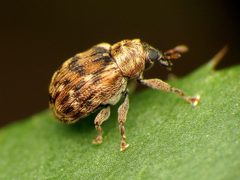
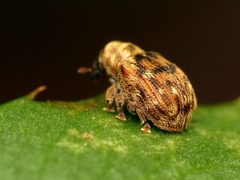
Piazorhinus pictus is a of true weevil in the Curculionidae, first described by John Lawrence LeConte in 1876. It is characterized by its distinctive coloration, as indicated by its specific epithet 'pictus' (meaning 'painted'). The species is known from eastern North America, with records from Canada (Manitoba, New Brunswick, Nova Scotia) and the United States. Despite a Wikipedia entry stating it occurs in South America, authoritative distributional records from GBIF and iNaturalist confirm a North American range. As a member of the Molytinae, it shares the typical weevil including an elongated snout or rostrum with mouthparts at the tip.
Pronunciation
How to pronounce Piazorhinus pictus: /ˌpiːəzoʊˈraɪnəs ˈpɪktəs/
These audio files are automatically generated. While they are not always 100% accurate, they are a good starting point.
Images
Distribution
Eastern North America. Documented occurrences include the Canadian provinces of Manitoba, New Brunswick, and Nova Scotia, as well as the northeastern and north-central United States. The appears to be associated with temperate deciduous and mixed forest regions.
Misconceptions
A Wikipedia article incorrectly states that this is found in South America. This appears to be an error, as all verified distributional records from GBIF and iNaturalist confirm a North American range. The confusion may stem from the Piazorhinus having broader distribution patterns, or from conflation with other weevil .
More Details
Taxonomic History
Described by John Lawrence LeConte in 1876, a prominent American entomologist who described thousands of North American beetles. The specific epithet 'pictus' likely refers to distinctive color patterns on the or body.
Data Quality Note
This has relatively few documented observations (58 on iNaturalist as of source date), suggesting it may be genuinely uncommon, under-collected, or difficult to detect. The limited observation count contributes to uncertainty regarding many aspects of its .