
Mecinus pascuorum
(Gyllenhal, 1813)
plantain weevil
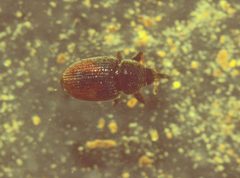
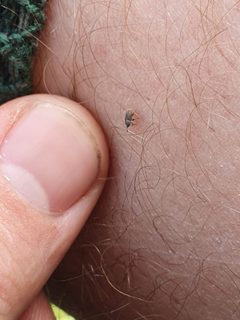
Mecinus pascuorum is a true weevil in the Curculionidae, commonly known as the plantain weevil. Native to the Palaearctic region, it has been introduced to New Zealand where it has become a regular post-harvest contaminant of kiwifruit. The is associated with narrow leaf plantain (Plantago lanceolata) as its primary plant. In New Zealand, it completes one per year with a brief stage and a long-lived stage of approximately 11 months.
Pronunciation
How to pronounce Mecinus pascuorum: /mɛˈkɪnʊs pɑˈskwɔrʊm/
These audio files are automatically generated. While they are not always 100% accurate, they are a good starting point.
Identification
Distinguished from other Mecinus by morphological characters of the rostrum, terminalia, and overall habitus. A taxonomic key to Palaearctic Mecinus species is available in the revision by Caldara and Korotyaev (2010). are small weevils typical of the , with the characteristic elongated snout of Curculionidae.
Images
Habitat
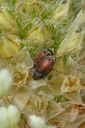
Associated with narrow leaf plantain (Plantago lanceolata) in grassland and meadow . In New Zealand, found in kiwifruit orchards, shelterbelts, and adjacent areas with plantain. overwinter in crevices in tree and vine bark, coarse shelterbelt litter, and foliage.
Distribution
Native to the Palaearctic region (Europe, North Africa, Asia). Introduced to New Zealand, where it is established in the North Island, particularly in South Auckland kiwifruit-growing regions. Also recorded from North America.
Seasonality
In New Zealand: active from October to mid-September. Light trap captures from October to mid-November. Peak abundance on narrow leaf plantain in early November. Newly emerged adults appear from late December, with majority emerging in January. Adults found in kiwifruit from late January until at least March.
Diet
Larvae feed internally on narrow leaf plantain (Plantago lanceolata) seed . may feed on plant tissues, though specific adult diet not documented.
Host Associations
- Plantago lanceolata - primary narrow leaf plantain; larval development occurs in seed
- Actinidia deliciosa - contaminantkiwifruit; found in fruit post-harvest, not a true pest
Life Cycle
One per year (). stage lasts approximately 2 months. stage lasts about 11 months. laid throughout November. Larval development occurs within plantain seed . New adults emerge from late December through January, dispersing by .
Behavior
are capable of and disperse from plantain to sites in bark crevices and litter. Attracted to light traps. Adults seek shelter in protected locations during winter months.
Ecological Role
Herbivore specializing on Plantago lanceolata. In New Zealand, acts as a passenger pest in kiwifruit production—present in harvested fruit without causing economic damage to the crop itself.
Human Relevance
Considered a contaminant pest in New Zealand kiwifruit industry. found in kiwifruit post-harvest can result in rejected export shipments due to regulations. No direct damage to kiwifruit vines or fruit; presence is incidental to proximity of plantain .
Similar Taxa
- Mecinus speciescongeneric weevils in the Palaearctic region; require examination of rostrum, terminalia, and other morphological characters for accurate identification
- Gymnetron specieshistorically confused with Mecinus; several transferred between ; distinguished by phylogenetic and morphological analysis
Sources and further reading
- BugGuide
- Wikipedia
- GBIF taxonomy match
- NCBI Taxonomy
- Catalogue of Life
- Encyrtid Holdings | Entomology Research Museum
- Flies at the window - Muscina pascuorum — Bug of the Week
- Strathmore B-Lines: Surveying Grasslands and Pollinating Insects in the Strathmore Valley - Buglife Blog - Buglife
- National Meadows Day 2022 in Northern Ireland - Buglife Blog - Buglife
- Phenology and ovarian development of the introduced weevil Mecinus pascuorum , a passenger pest of kiwifruit in New Zealand
- Systematics of the weevil genus <i>Mecinus</i> Germar, 1821 (Coleoptera: Curculionidae). I. Taxonomic treatment of the species